Digital Job Cards Cut Six Calls Per Job to One
Count the last job you quoted a customer on. Not the hours on the car. The calls. One to send the quote. One to chase the approval. One to confirm the part arrived. One to say the car is ready. One to follow up on payment. One to ask for a review. That is six phone calls for one job, and not a single minute of it goes on an invoice.
Five calls, three voicemails, one job going nowhere. Sound familiar? That is not a you problem. That is a process problem. And digital job cards are the single most direct fix for it.
Why Does Every Job Generate Six Phone Calls?
The six-call loop exists because information lives in too many places at once. The quote is in your email. The approval is in a text message. The parts status is in your head or on a sticky note. The customer has no visibility, so they ring to ask. You have no record of what was said, so you ring back to confirm.
Every handoff between people that is not written down creates a phone call. Simple as that.
The traditional paper job card did not solve this because it only recorded what happened after the fact. It was a receipt, not a live record. The job still ran on phone calls and memory.
What a Digital Job Card Actually Does Differently
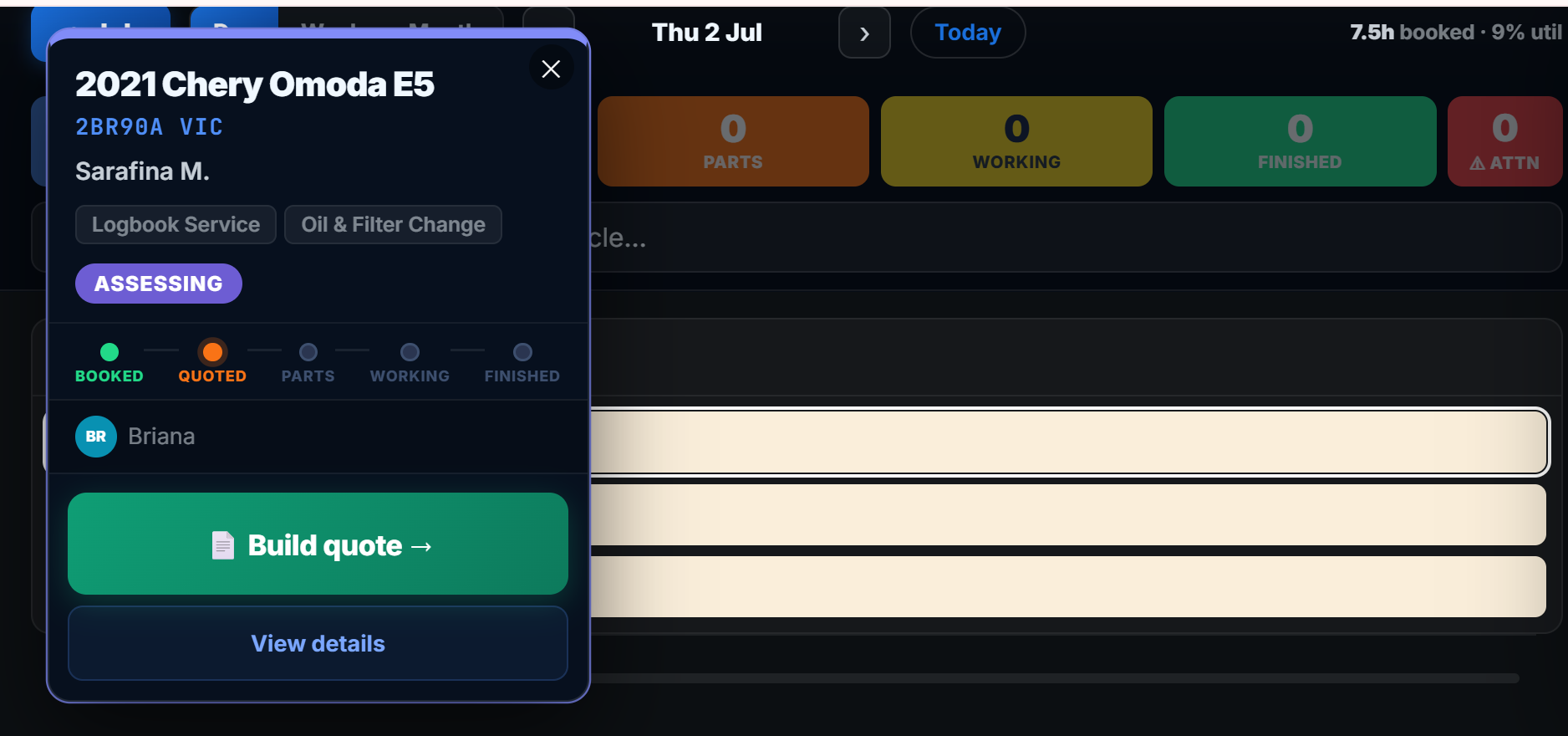
A digital job card is a living document. It captures the fault, the quote, the customer approval, the parts order, the labour logged, and the final invoice in one record that moves with the job in real time.
Here is where each call gets killed:
- The quote call. The quote goes to the customer as a link. They read it on their phone, tap approve, and you get a notification. No phone tag, no waiting by the handset.
- The approval chase. If they have not opened it in a set time, an automatic reminder goes out. You do not make that call. The system does.
- The parts update. When the part is ordered and confirmed, that status updates on the card. You know. The car does not move until it is ready. No one needs to ring anyone.
- The ready notification. An automated message goes to the customer the moment the job is marked complete. That call disappears entirely.
- The payment follow-up. Digital invoices with a payment link mean far fewer people walking out saying they will pay Friday. The friction is gone, so the delay mostly goes with it.
- The review request. Sent automatically at close. You do not have to remember and you do not have to feel awkward asking.
What is left? One call. The one that actually matters. The conversation where you explain what you found and what it means for the customer's car. That call should never be automated, and it does not have to be.
The Old Way vs the New Way: A Straight Comparison
| Step | Paper-based process | Digital job card |
|---|---|---|
| Quote delivery | Phone call or walk-in | Link sent automatically |
| Customer approval | Phone call, sometimes multiple | One tap on a link |
| Parts sourcing update | Manual call to supplier, manual update to customer | Supplier status updates on the card |
| Ready notification | Phone call when you remember | Automated at job completion |
| Payment | At counter, or chase the "I'll pay Friday" customer | Invoice link at car handover |
| Review request | Awkward ask at the counter, or never | Automated follow-up |
| Dispute resolution | Verbal recall, paper notes, no photos | Full record, images, approval timestamp |
Verdict: the digital process does not require a faster workshop or more staff. It requires a different system. The time savings are baked into the structure, not the effort.
What About the Parts Hunt , That Is Its Own Phone Loop
The six-call count above does not even include sourcing the part. That can be another three or four calls on its own. Ring Supplier A, they are out of stock. Ring Supplier B, hold music, a callback that comes when you are under a car. Ring Supplier C, they have it but the price is steep and you have no time to push back.
A workshop full of diagnostic computers and the parts hunt is still a sticky note and a phone. That is the part nobody writes on the invoice.
One clean fix here is SparesIN, the auto-parts marketplace, where a workshop posts the part it needs and vetted local suppliers compete to fill it, with the result dropping straight into a Meckly quote. Unlike most marketplaces it is not open to anyone with a part to sell. Suppliers are verified shops vouched for by real workshops. It is properly business-to-business. And it does not change how a workshop pays or collects, which means cleaner records and easier returns when something is not right. It is free to use and it kills the ring-around cold.
The Dispute Problem Nobody Wants to Talk About
Here is the one that stings. A customer approves a $900 job verbally over the phone. You do the work. At pickup they say they thought it was $600 and they are not happy. No written approval, no record of exactly what was quoted, no photos of the fault that justified the work.
You are not going to win that conversation. You might not even get paid for it.
Digital job cards close this completely because the approval is timestamped, the quote is on record, and the customer physically tapped a button to say yes. But the sharpest version of this is having the diagnostic images sitting directly on the quote itself, not in a separate folder, not in a different app, not printed and stapled to something later. The photo of the fault lives next to the line item and the price the customer sees. One source of truth. The evidence sits with the quote. That is the thing that kills disputes before they start and builds the kind of trust that earns a five-star review instead of a one-star complaint.
Most workshop platforms store images in a separate gallery or need a second piece of software to attach them properly. Meckly puts them on the quote itself. A small detail with a large outcome.
Is This Only Relevant for Bigger Workshops?
No. The opposite is true. In a dealership with a service team, the admin load gets spread across multiple people. In a two-person independent workshop, every call the owner takes is a minute away from the tools. The six-call loop hurts small shops harder because there is no one else to absorb it.
Forty minutes of unbillable phone time a day does not sound dramatic. Across a five-day week that is over three hours. Across a year, for a workshop billing at a standard hourly rate, that number is significant. And it is recoverable, with the right system.
Frequently Asked Questions
What are digital job cards and how do they work in an auto workshop?
A digital job card is an electronic record that follows a vehicle from the moment it arrives to the moment it leaves. It captures the diagnosis, the quote, customer approval, parts ordered, labour time, and the final invoice all in one place. The workshop owner and the customer both know exactly where the job stands without anyone picking up a phone.
How do digital job cards reduce the number of phone calls per job?
Most of those calls are status updates , quote approval, parts confirmation, job progress, pickup notification, payment reminder, review request. A digital job card automates or eliminates every one of those because the information is already visible to both sides. The customer approves the quote in a link, not a phone call. Pickup notification goes out automatically. One quick call stays for the conversation that genuinely needs a human.
Are there free ways to source parts without ringing around?
Yes. SparesIN, the auto-parts marketplace, lets a workshop post the part it needs and have vetted local suppliers compete to fill it, integrated directly into a Meckly quote. Suppliers on the platform are verified businesses vouched for by real workshops, so it is properly business-to-business rather than a free-for-all. It does not change how a workshop pays or collects, it just cuts the ring-around.
What is the real cost of the six-call loop for a workshop?
Each of those six calls runs two to five minutes once you add hold time, voicemail tags and callbacks. Across a day of four to six jobs that is easily forty minutes of unbillable time, every single day. Across a year for a small workshop it adds up to hundreds of hours that nobody invoices for and nobody gets back.
Do digital job cards work for small independent workshops, not just dealerships?
They are genuinely better suited to small independents than to large dealers, because in a small shop every minute the owner spends on the phone is a minute they are not on the tools. The setup cost for good workshop management software has dropped significantly, and the time recovered is felt immediately in a team of two or three where everyone wears multiple hats.
What should I look for when choosing workshop management software with digital job cards?
Look for a system where the quote, the diagnostic images, the customer approval, and the parts order all live in one record without needing a second app. If photos of the fault sit somewhere separate from the quote the customer sees, you have already split your source of truth and disputes get harder to resolve. The fewer logins and platforms involved, the faster a job moves.
The One Call You Keep
The goal is never zero calls. The goal is one call per job. The one where you tell a customer what you found and what you recommend. That conversation is why they chose your workshop over the one down the road. It builds trust, it generates return visits, and it cannot be automated.
Everything else can be. And for the workshop that makes that shift, the count goes from six calls to one. Not because they work harder. Because the process finally works for them instead of against them.
If you want to see what that looks like in a real workshop setup, start a free trial with Meckly and have someone walk you through it. Or browse the training guides if you want to move at your own pace. Either way, the six-call loop is optional. Most workshops just do not know that yet.