Quote Approval Delays. What a Silent Bay Costs You
Add up every minute you spent last week waiting on a customer to approve a quote. Not the time fixing the car. Not the time sourcing parts. Just the waiting. The bay sitting there. The job half-started and parked. If you haven't done that sum before, the number will make you put the phone down.
Quote approval delays are the most invisible cost in an independent workshop. They don't show on a P&L. They don't trigger an alert. They just quietly turn billable hours into dead air, day after day, and most owners have no idea how much it adds up to.
What does a quiet bay actually cost per hour?
Start with your hourly rate. For most independent Australian workshops that's somewhere between $130 and $180 per hour per bay. An idle bay isn't making nothing. It is actively costing you the revenue it should have generated.
One bay. Two hours waiting on an approval. Call it $150 per hour. That's $300 gone before the afternoon. Five days a week, that's $1,500. Across a year, even if it only happens twice a week, you're looking at well over $30,000 in capacity that evaporated not because you ran out of work, but because a customer hadn't tapped their phone.
The process is the villain here. The customer isn't being difficult. They just didn't have a reason to move fast.
Why do customers sit on quotes in the first place?
There are three honest reasons and they're all fixable.
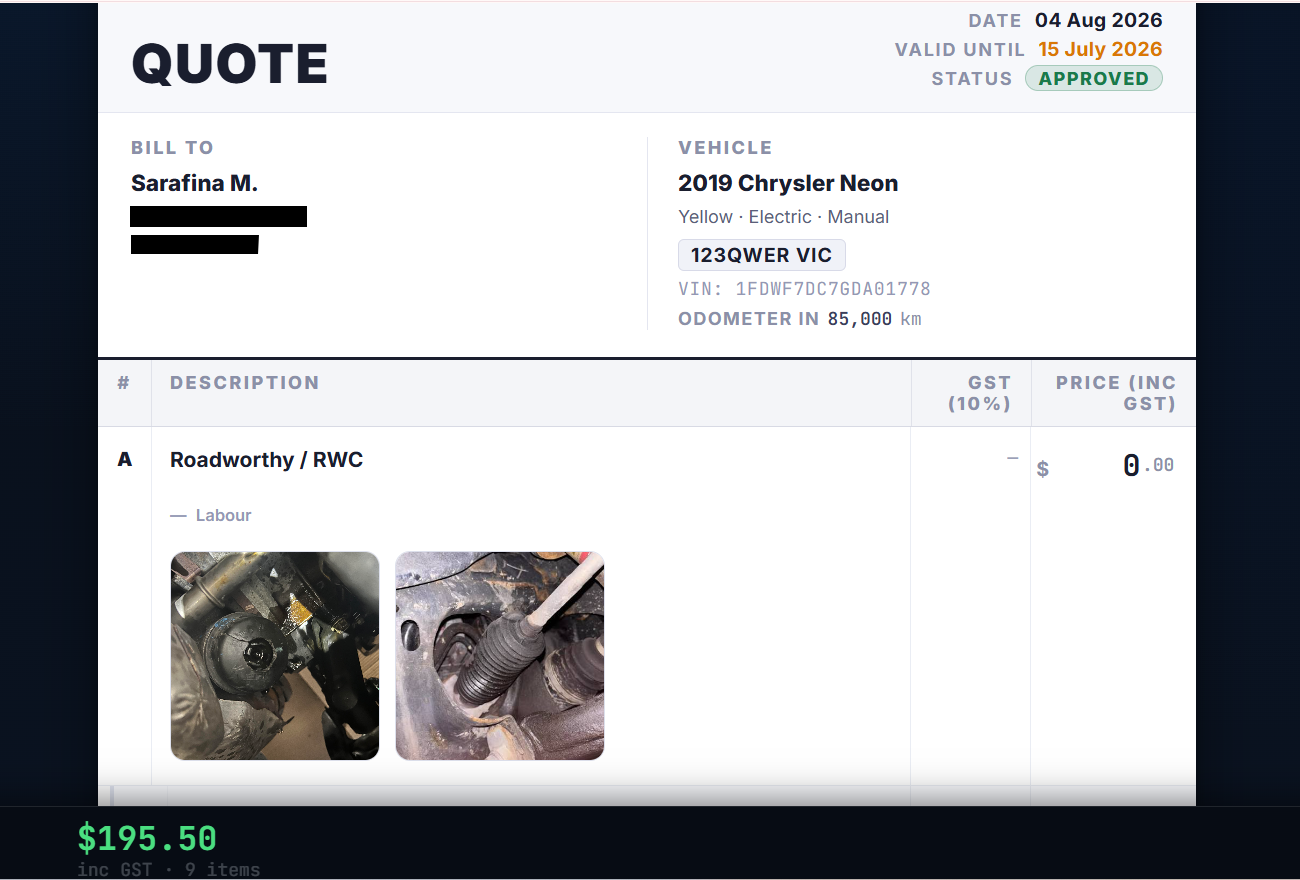
- The quote arrived with no context. A PDF with line items and dollar figures but no photo of the actual problem. The customer sees a number and goes quiet because they can't picture what they're paying for. Every day of silence is a day the bay waits.
- Approval required a phone call back. The customer is at work, in a meeting, with kids. They'll ring when they get a chance. Which is never urgent. Which means tomorrow, maybe.
- The quote took too long to land. You were still chasing parts prices when the customer expected an answer by midday. By the time the quote arrived they'd half moved on.
All three of those are process problems. None of them are about the customer's willingness to spend money on their car.
The old way versus the faster way: an honest comparison
| The old way | The faster way |
|---|---|
| Quote built in a notepad or spreadsheet, emailed as a PDF | Quote built in your management software, sent as a link the customer opens on their phone |
| Photos saved to your phone's camera roll or a separate folder | Photos attached directly to the quote, sitting next to the line item and price |
| Approval means the customer rings you back | Approval is one tap on a mobile-friendly quote |
| Parts prices chased by phone, one supplier at a time | Part posted to a verified marketplace, multiple prices return while you're still at the car |
| Bay sits idle while all of the above takes its time | Quote out fast, customer decides fast, bay turns over fast |
The verdict up front: the old way isn't wrong, it's just slow by design. Every manual step adds latency. And latency is the bay sitting idle.
Every option for solving this, and where each one falls short
Let's be straight about what's available, because there are a few paths and none of them are perfect without the others.
- A) Chasing the customer harder. More follow-up calls, more texts. It feels proactive. In practice it annoys customers, takes your time, and doesn't solve the root cause. The quote still had no photo. Approval still needed a phone call. You just added friction on your end too.
- B) A simpler quote template. Removing detail to make the quote less scary. This cuts disputes, a little. But a simple number with no evidence still leaves the customer guessing what they're paying for. Approvals stay slow.
- C) Generic quoting software or a basic job management app. Better than a spreadsheet. But most of these store photos somewhere else entirely. The customer gets a quote. The photos are in your camera roll, or a Dropbox folder, or a separate app you have to flick between. The evidence and the quote are two separate things. That gap is where trust and speed both fall over.
- D) A full workshop management platform that keeps the photo on the quote. This is where the maths changes. When the photo of the cracked CV boot, the worn rotor, the seized caliper sits right next to the line item the customer is approving, two things happen every time. They approve faster because they can see exactly what they're paying for. And disputes drop because there's no argument about what was found. One source of truth. The evidence lives with the quote.
Most platforms separate these two things. Meckly doesn't. The diagnostic image saves directly on the quote itself. No second app, no folder to dig through, no hoping the customer takes your word for it. That's not a feature you'd think to ask for until the day a customer rings to dispute a job and you can pull up the quote, the photo, and the approval timestamp in one screen.
The parts delay that slows the quote before it even leaves your hands
There's a step before the customer delay that most workshops don't track separately. The quote approval delay often starts in your own shop, not the customer's inbox.
You can't send a quote until you know what the parts cost. And if sourcing those parts means ringing three suppliers, leaving a voicemail at two of them, and waiting on a callback, the quote doesn't go out at 9am. It goes out at 2pm. And the customer, who was ready to decide at 9am, is now at work and won't check their phone until tonight.
That's where SparesIN, the auto-parts marketplace, changes the sequence. Instead of you ringing around, you post the part you need and vetted local suppliers compete to fill it. Suppliers are verified businesses, vouched for by real workshops. It's properly business-to-business, not a free-for-all open to anyone with stock in a boot. You get multiple prices returned to you, integrated straight into the Meckly quote, before your coffee's cold. The quote goes out earlier. The customer has more of their day left to approve it. The bay sits idle for less of yours.
It doesn't change how you pay or how you trade. The records just end up cleaner, which makes things like returns easier to manage.
The quiet maths nobody adds up
The bay sits idle. The car waits. And you wait with it. That's not a bad day. That's a system with the wrong design. The good news is the design is the thing you can actually fix.
Build the quote faster. Attach the evidence to the quote, not to a separate folder. Send it in a format the customer can approve from wherever they are. Do those three things consistently and the delay shrinks on its own. Not because customers suddenly got more decisive. Because you removed every reason for them to pause.
If you want to see what that looks like end to end, start a free trial with Meckly and bring one quote to life the way it should work. The first time a customer approves before you've finished the walk-around, you'll know the number you should have been tracking all along.
Frequently asked questions about quote approval delays
How much does a quote approval delay actually cost an Australian workshop?
It depends on your hourly rate and how many bays you run, but even one idle bay for two hours a day at $150 per hour is $300 lost before lunch. Multiply that across a working week and the number gets uncomfortable fast. The real cost is rarely tracked, which is why most workshops underestimate it.
What are the main reasons customers delay approving a repair quote?
The three most common reasons are that the quote arrived with no visual context so the customer isn't sure what they're paying for, the quote sat in an inbox or voicemail they didn't check, and the customer wanted to think about it but had no easy way to approve on their phone. A quote with a photo of the actual problem attached gets answered faster than a text-only PDF.
What can a workshop do right now to reduce quote approval delays?
Send the quote digitally so the customer can approve from their phone without ringing you back. Attach a photo of the fault directly to the quote so the customer can see what they're approving and why it costs what it costs. If parts sourcing is holding up the quote itself, post the part needed to a verified supplier marketplace so you get prices quickly and build the quote faster.
Is waiting for quote approval a normal part of running a workshop?
It's common, but it's not inevitable. The delay is almost always a process problem, not a customer problem. When the quote is clear, has evidence attached, and can be approved with one tap, most customers move quickly. The friction lives in how the quote is built and delivered, not in the customer's willingness to spend.
Does attaching photos to a quote really reduce disputes and speed up approvals?
Yes, consistently. When the customer can see the cracked CV boot or the worn rotor sitting right next to the line item and price, two things happen. They approve faster because they're not guessing. And disputes drop because there's no ambiguity about what was found and what it cost. The photo is the evidence, and when it lives on the quote itself rather than in a separate folder, nothing gets lost.
What is the difference between SparesIN and ringing suppliers directly?
Ringing around is one call per supplier, one price at a time, on your time. SparesIN, the auto-parts marketplace, flips it. You post the part you need and vetted local suppliers compete to fill it, so multiple prices come to you. Suppliers on SparesIN are verified businesses vouched for by real workshops, not open to anyone with a boot full of old stock. It doesn't change how you pay or how you trade, it just cuts the sourcing time so you can build and send the quote before the bay goes cold.