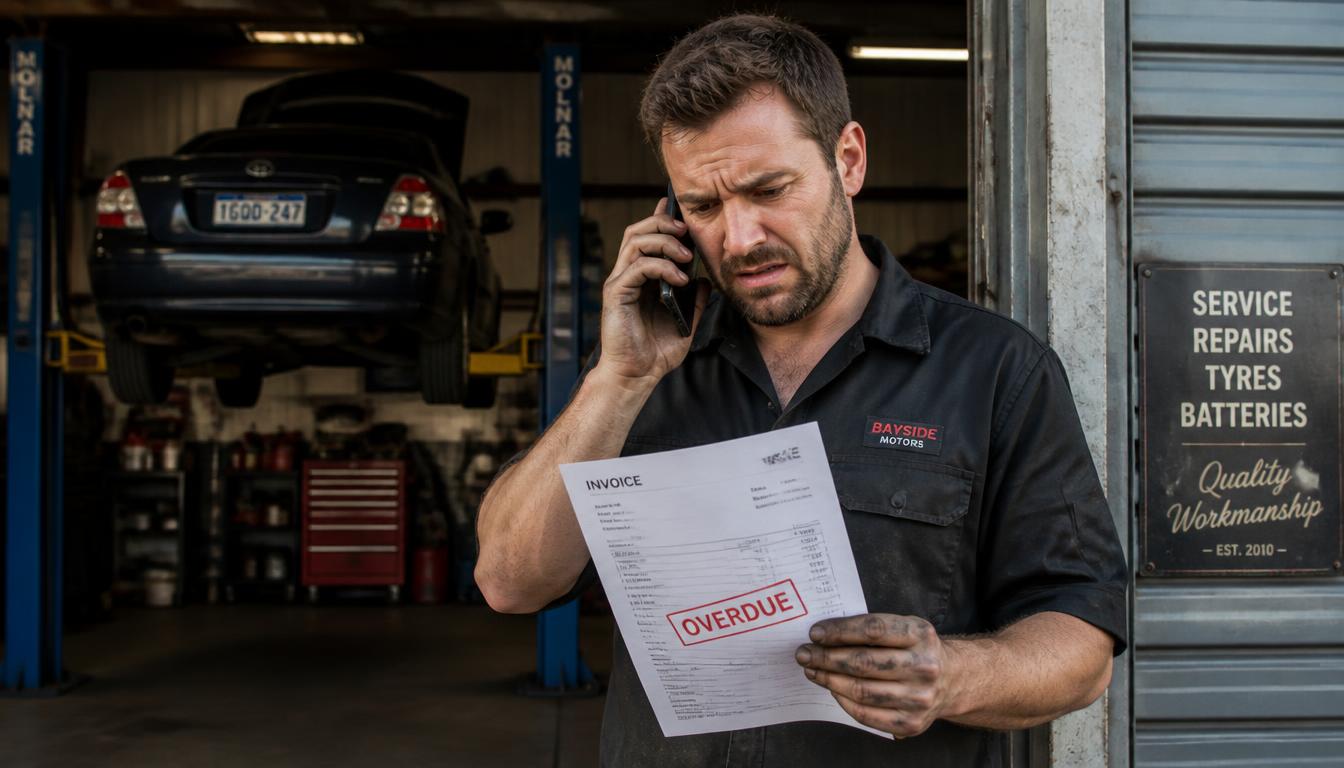
The Real Cost of One Overdue Invoice a Week
Add up every minute you spent last week chasing a single unpaid invoice. The calls. The texts you worded carefully so they didn't sound threatening. The voicemail you left and the one they didn't return. The moment on Friday afternoon when you decided to let it sit over the weekend. Now multiply that across 52 weeks. The overdue invoices small workshop owners carry aren't just a cash flow problem. They are a time problem, and time in a workshop bay has a very specific dollar value attached to it.
Here is the honest maths most owners never do.
What does one overdue invoice a week actually cost you?
Call it 45 minutes per chase. That is conservative. One initial call, a follow-up text, a second call three days later, and a final message before you decide whether to write it off or escalate. Forty-five minutes, once a week, is 39 hours a year. At a workshop labour rate of $150 per hour, that is $5,850 of your time spent on work that produces nothing. No part replaced. No car fixed. No job closed.
And that figure does not count the mental load. The low-grade irritation of watching a name sit in your aged receivables column. The moment you see that customer's number come up on your phone and feel the flicker of dread before you answer.
The most expensive invoice is the one you keep chasing. Not because of the original amount on it. Because of everything else it quietly costs while you are focused on it.
Where does the problem actually start?
Most workshop owners put the problem at the back end. The customer didn't pay. So the fix must be at the back end too: tougher reminders, a late fee in the terms, maybe a debt collector if it gets bad enough.
That thinking is understandable and it is also wrong. By the time an invoice is overdue, you have already lost something. The job is done. The parts are fitted. The car is gone. Your leverage is essentially zero.
The problem starts at the front of the job, not the back. It starts when there is no clear agreement about when payment is due. It starts when the customer receives a quote with no deposit requirement. It starts when the invoice goes out as a PDF attached to an email they may or may not open, with no clear way to pay on the spot.
\p>Every step that adds friction between the work being approved and the money arriving is a step that creates overdue invoices. The process is the villain, not the customer.The four ways workshops try to fix this (and where each one falls short)
There is no shortage of advice on recovering overdue invoices. Here is an honest look at what actually works and what does not.
- Stricter payment-on-pickup policies. This works well for new customers and straightforward jobs. It breaks down when a regular customer pushes back, when a fleet account is involved, or when the car sits in your yard because the customer cannot pay and you cannot release it. The policy is sound. The enforcement is awkward without a system behind it.
- Requiring a deposit before parts are ordered. This is probably the single best structural change a small workshop can make. It shifts the moment of financial commitment to before the work starts, not after. The objection is that some customers will go elsewhere. In practice, most do not. A customer who will not put down a deposit on a major repair is often the same customer who will not pay the invoice on time.
- Accounting software reminders. Xero, MYOB, and similar platforms send automated overdue reminders, which is better than doing it manually. The gap is that these tools sit outside the job workflow. The customer receives a reminder with an invoice number but no context. They cannot see the approved quote, the parts list, or the photos of what was wrong. Disputes arise from missing context, and accounting software cannot fill that gap.
- Debt collection or legal action. For genuinely bad debts, sometimes necessary. Under Australian Consumer Law, you have rights around unpaid invoices for goods and services, but the process is slow, often costs more in time than the debt is worth, and rarely recovers the relationship. Check with your accountant or a legal adviser about your specific situation before going down this path. It is a last resort, not a system.
The old way vs the new way: a plain comparison
| The old way | The new way |
|---|---|
| Quote sent as PDF, job done, invoice emailed separately | Quote, approval, job, invoice in one connected workflow |
| Payment chased manually by phone or text | Automated reminders go out without you touching it |
| Customer disputes the bill, no easy evidence | Diagnostic photos sit on the quote, customer saw them before approving |
| Parts sourcing delays push jobs out, customer frustration rises | Faster parts turnaround means jobs close when expected |
| Aged receivables live in a spreadsheet you check occasionally | Overdue items visible on the dashboard every morning |
Verdict: the old way puts the chase on you. The new way changes the moment of obligation before the chase becomes necessary.
The parts delay connection most owners miss
There is a link between slow parts sourcing and overdue invoices that almost nobody talks about. When a job runs three days longer than you quoted because a part took time to track down, the customer's frustration has had three extra days to build. By the time the invoice arrives, they have already mentally deducted something for the inconvenience. The dispute is more likely. The payment is slower.
Faster parts sourcing is not just an efficiency gain. It is an indirect invoice management tool. A job that closes on time is a job that invoices cleanly, to a customer who is not already annoyed.
One way to cut that sourcing time is SparesIN, the auto-parts marketplace where a workshop posts the part it needs and vetted local suppliers compete to fill it, integrated straight into a Meckly quote. Unlike open marketplaces, suppliers on SparesIN are verified businesses vouched for by real workshops. It is properly business-to-business. The way you pay and collect stays the same. The difference is you stop ringing around and start receiving prices instead. You can see how it works here.
The evidence problem underneath every invoice dispute
A customer who disputes an invoice is usually a customer who felt surprised by it. Either the scope changed without clear communication, or the final number was higher than they expected, or they simply cannot remember approving the work. The cure is not a tougher tone in your reminder emails. The cure is evidence attached to the moment of approval.
This is where most workshop platforms fall short. They store job notes in one place, photos in another, and the approved quote somewhere else. By the time a dispute arrives, you are pulling screenshots from three different apps to make your case.
In Meckly, the diagnostic images are saved directly on the quote itself. The photo of the worn rotor sits right next to the line item and the price the customer approved. When they sign off on the quote, they are signing off on the evidence and the cost at the same time. One source of truth. No second app. No hunting for the photo you know you took.
That setup does not just help in disputes. It changes the dynamic before any dispute starts. A customer who saw the cracked CV boot in the photo before they approved the job is not going to argue about the invoice when the car is ready. The conversation already happened.
What this actually looks like at the end of a year
Go back to that 39 hours. Now add the invoices you quietly wrote off because the chase cost more than the amount. Add the jobs you held off booking because your receivables were stretched and you were quietly uncertain about cash flow. Add the Friday afternoons you spent on the phone instead of with your family or on the tools doing work that actually pays.
One overdue invoice a week is not a small admin problem. It is the shape of a system that is working against you. Change the system and the invoices stop being overdue in the first place.
That is the only version of this problem worth solving.
Frequently asked questions
How much does chasing overdue invoices actually cost a small workshop?
The time cost alone is significant. If chasing one overdue invoice takes 45 minutes of calls, messages, and follow-up, and you're doing that weekly, you're losing around 39 hours a year on that single habit. At a modest labour rate, that is real money written off against work you never get paid for.
What are the main options for reducing overdue invoices in an auto repair shop?
Most workshops try one of four things: stricter payment-on-pickup policies, requiring a deposit before parts are ordered, using accounting software to send automated reminders, or switching to workshop management software with integrated invoicing. Each has a role, but the biggest gains usually come from removing the friction between the quote being approved and the invoice being paid.
Is it legal to charge a fee for late payment in Australia?
Generally yes, provided the fee is disclosed upfront in your terms and is a genuine estimate of your administration cost, not a penalty. The Australian Competition and Consumer Commission and relevant state fair trading bodies have guidance on this. Check with your accountant or a legal adviser before adding late fees to your terms, as the rules can vary by state and contract type.
How does workshop management software help with overdue invoice recovery?
Good workshop management software reduces overdue invoices in two ways. First, it creates a clear paper trail from quote to job to invoice, so there is no ambiguity about what was agreed. Second, it allows automated payment reminders to go out without you picking up the phone, which removes the awkward personal chase and gets results faster.
What is the best way to deal with a customer who keeps saying they will pay Friday?
The best structural fix is to change the moment of payment before that habit forms. Payment on pickup, or at least a deposit before parts are ordered, shifts the obligation earlier in the job. For existing slow payers, a written payment plan confirmed via your workshop software creates a record under Australian Consumer Law that protects you if the matter escalates.
Can parts sourcing delays make the overdue invoice problem worse?
Yes, and this is underappreciated. When a job runs longer than quoted because parts took extra time to source, customer frustration rises and disputes about the final bill become more likely. Faster, more transparent parts sourcing means jobs close on time, invoices go out when expected, and customers pay before they have had time to feel aggrieved.