Workshop Google Reviews. Why Timing Is Everything
The review gets written the day of the bill shock, not the day the car drives out sweet. That single fact explains why workshops with genuinely good work are sitting on a 4.1 when they deserve a 4.8. And it means the fix has nothing to do with working harder.
It is a timing problem. And timing is something you can actually control.
Why do good workshops still have low Google ratings?
Think about who actually goes home and writes a workshop Google review without being asked. It is almost never the customer who is quietly happy. It is the person who felt surprised by the invoice, who had to wait an extra day, whose expectation was missed somewhere. That person acts on emotion, immediately.
The happy customer means to write one. Genuinely means it. Then the afternoon happens, and then the week, and then the moment is gone.
This is not a loyalty problem. It is a friction and timing problem. The person who had a great experience needs a small prompt, at exactly the right moment, to convert intention into action. Get the timing wrong and even your best jobs vanish from your rating permanently.
What is the wrong moment to ask for a review?
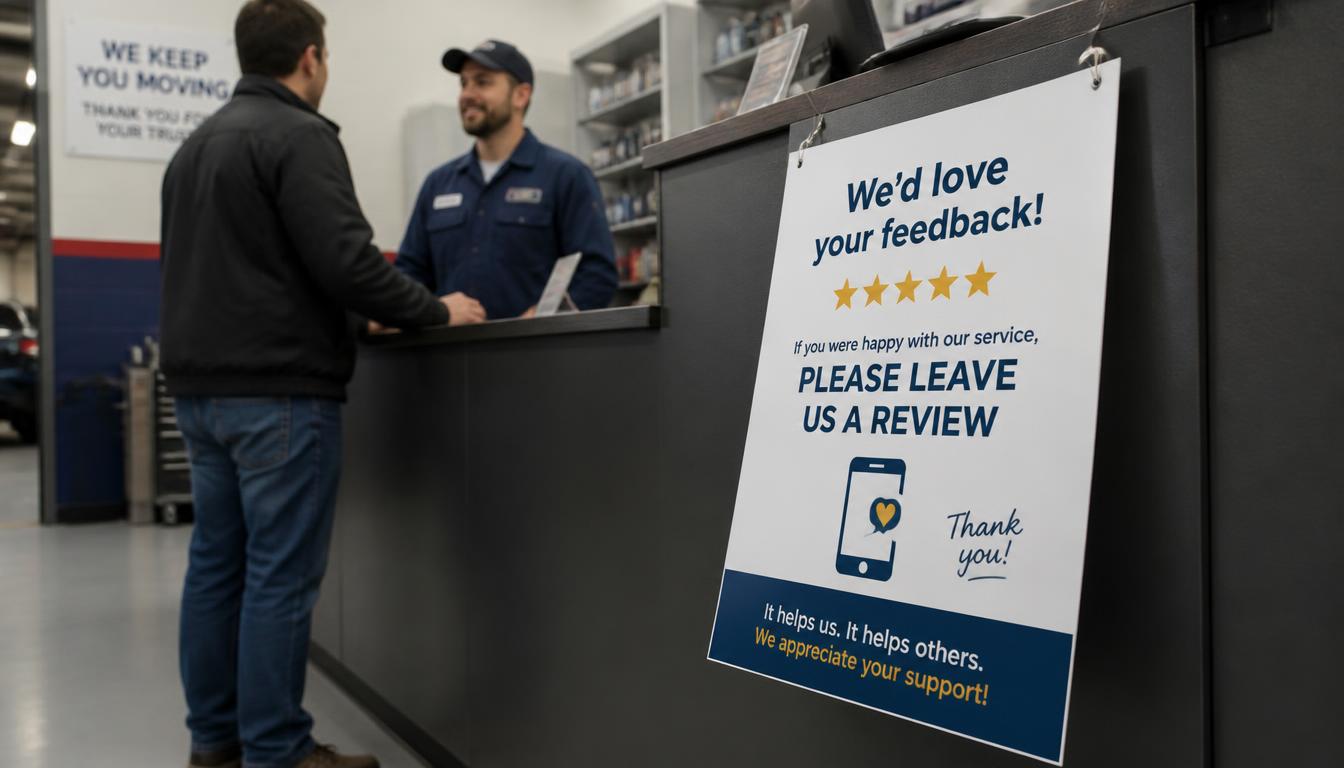
The counter at handover. Right there, invoice in hand, is the worst possible time to ask.
Even when the job has gone perfectly, the customer's brain in that moment is processing a number. Bigger than they remembered. Maybe bigger than the quote, even if every cent is justified. The dominant emotion is sticker shock, not gratitude. Asking for a review there is asking someone to write about how they feel right now, which is not how you want the story to start.
The options most workshops use, and where each one falls short:
- The in-person ask at the counter. Feels natural, lands at the worst emotional moment. Conversion is low and the reviews you do get tend to be lukewarm.
- A printed card in the glovebox. Virtually zero follow-through. Out of sight within twenty minutes.
- A generic SMS blast weeks later. The customer has moved on. The connection to the experience is cold. Easy to ignore.
- Not asking at all and hoping. This is where most workshops are. The only reviews that arrive are the ones driven by strong emotion, which skews negative.
None of these are wrong because the workshops using them are doing something wrong. The process is the problem, not the people running it.
When is the best time to ask a customer for a Google review?
One to two days after pickup. That is the window.
By then the customer has driven the car. The rattle is gone. The brakes feel right. The relief has settled in and the invoice is a memory, not a fresh sting. That is the emotional state you want to capture in a review.
A short message at that moment, warm and specific, converts far better than anything you do at the counter. It does not need to be long. It needs to be timely, and it needs to feel like it came from a person, not a system.
Something like: