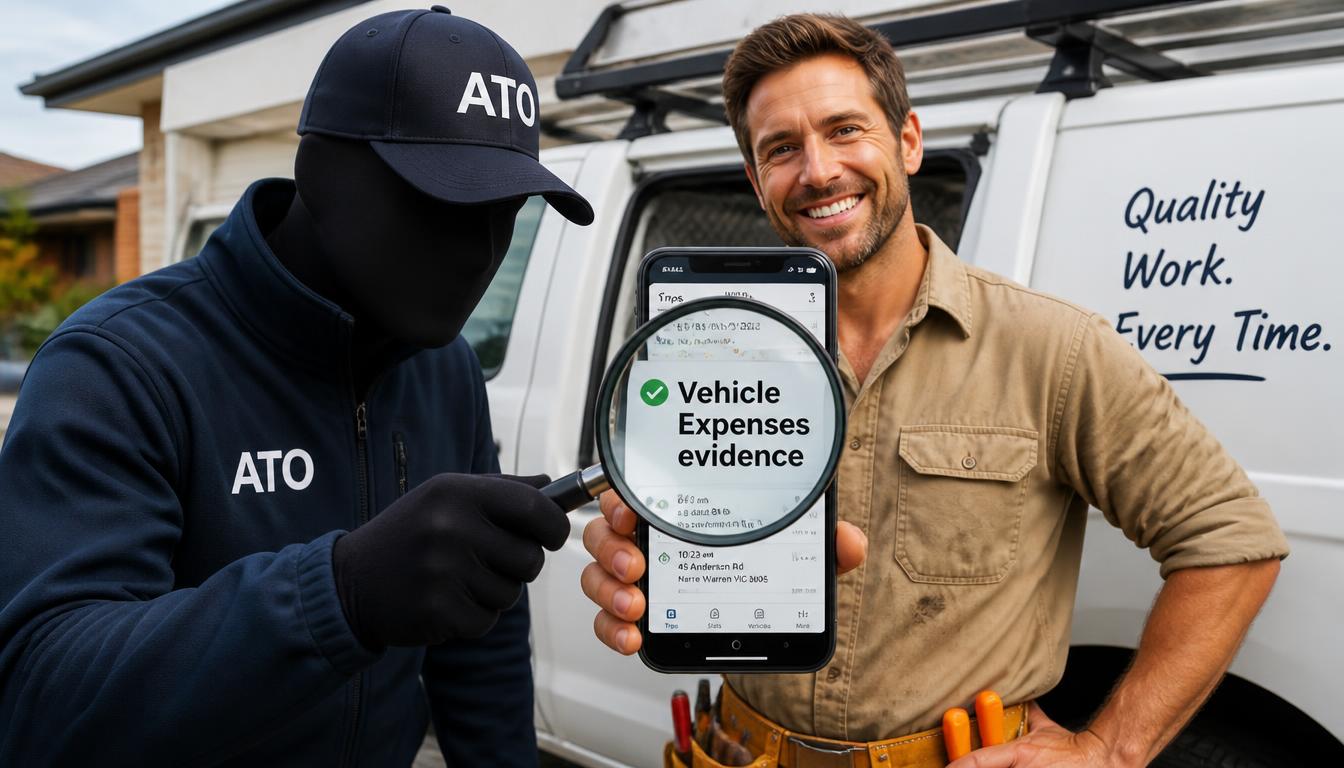
Car Expenses Tax Claim Australia. What You Can Actually Claim
Australians claim approximately $10.6 billion in car and travel deductions every tax year. That is a staggering number. And the uncomfortable truth sitting inside it is this: a large chunk of legitimate car expenses tax claims in Australia go unclaimed every single year, not because people aren't entitled, but because their records are a mess. A drawer of crumpled invoices. A shoebox. A vague memory of a service that cost somewhere around $400 in March.
By the time July rolls around, the deduction is gone. Not because the ATO took it. Because you couldn't prove it.
Who Can Actually Claim Car Expenses on Tax?
The ATO is clear that you can claim a deduction for vehicle expenses when you use your car in the course of earning income. That covers a wide range of everyday Australians.
- Tradies driving to job sites (not just home to the depot and back)
- Nurses, teachers and sales reps who travel between locations during the day
- Small business owners using their personal car for client visits or deliveries
- Anyone required to carry heavy equipment that genuinely cannot be stored at a fixed workplace
What is generally not claimable is the trip from your front door to your regular, fixed workplace. The ATO calls that private travel. It doesn't matter how far you drive or how early you leave. Check this with your accountant if your situation is at all unusual, because the exceptions are narrow and the ATO does look.
What Car Expenses Can You Actually Claim?
For the work-related portion of your vehicle use, the ATO generally allows claims on the following.
- Fuel and oil
- Servicing and repairs
- Tyres
- Registration and CTP insurance
- Comprehensive insurance premiums
- Loan interest (not the principal repayment, only the interest component)
- Depreciation of the vehicle's value
- Lease payments if the car is leased
The catch is that you can only claim the percentage that reflects genuine work use. If 40% of your driving is for work, you can claim 40% of those costs. Inflate it and you are taking a risk that is not worth taking.
The Two Methods: Which One Puts More Money Back?
The ATO offers two ways to calculate your car expenses tax claim in Australia. They work very differently and suit different situations.
Method 1: Cents Per Kilometre
You claim a set ATO rate per kilometre for work travel, capped at 5,000 kilometres per year. As of the 2024-25 financial year, the rate set by the ATO is intended to cover all your running costs in one figure. No receipts required, but you need a reasonable way to work out the kilometres, such as a diary or calendar entries.
Good for: Lower business use, people who don't want to keep detailed records, or those whose actual costs are modest.
Where it falls short: The 5,000km cap is a hard ceiling. If you drive more than that for work, you leave the excess on the table. For a tradie or a rep doing serious kilometres in a vehicle with high running costs, this method often returns far less than the alternative.
Method 2: Logbook
You keep a logbook for at least 12 continuous weeks, recording every trip, the purpose, the odometer readings and whether it was work or private. That establishes your business-use percentage. You then apply that percentage to every actual expense across the full year, including depreciation.
If your logbook shows 70% business use, you claim 70% of every relevant cost. No cap on kilometres. If your logbook shows 85% business use, you can claim 85% of all running costs plus 85% of the vehicle's depreciation. For a vehicle with high running costs, that is a substantially larger deduction.
Good for: High business use, expensive vehicles, anyone whose actual costs are significant and well-documented.
Where it falls short: It requires discipline upfront and complete records throughout. A logbook without receipts to match is only half the job. And if you can't produce the invoices at review, the ATO can disallow the claim.
At a Glance: Which Method Suits You?
| Factor | Cents per km | Logbook |
|---|---|---|
| Receipts needed | No | Yes, all of them |
| Kilometre cap | 5,000km/year | No cap |
| Depreciation claimed | Included in rate | Claimed separately |
| Setup effort | Low | 12 weeks of records |
| Best for | Low-use, simple situations | High-use, higher deductions |
| Logbook valid for | N/A | 5 years (if use stays consistent) |
Your accountant should help you decide which method suits your situation. The numbers only work if the method matches your actual driving pattern.
The Part Most People Get Wrong
Most of that $10.6 billion never gets claimed at all. Not because people drove fewer kilometres than they thought. Because they couldn't find the receipts when it mattered.
The logbook method in particular lives or dies on documentation. Every service invoice, every tyre replacement, every registration renewal. If you choose to claim actual expenses and then present your accountant with a partial stack of paperwork, you are leaving a real deduction behind and handing the ATO grounds to question the rest.
This is the part the process makes harder than it needs to be. Invoices arrive from different workshops. Some are emailed. Some are handed over the counter on paper. Some get stuffed in the glovebox. Come July, you are reconstructing twelve months of spending from fragments.
How to Keep Your Records Without Losing Your Mind
A few practical things that make tax time genuinely easier.
- Start the logbook properly and finish it. Twelve weeks of consistent entries is all you need for a five-year logbook. Don't start one you won't finish. A partial logbook is worse than none at the wrong moment.
- Ask every workshop to email the invoice. Paper receipts disappear. Digital ones do not. Most workshops can send one on the spot.
- Keep one folder, not five. Whether that's a folder in your email, a cloud drive, or something more organised, the goal is one place you look every time. The moment you have two systems you have no system.
- Record the purpose of each work trip at the time. Memory is unreliable. A quick note on the day beats a reconstruction three months later.
If you use Meckly to connect with any workshop that runs it, your service records and invoices from that shop are already stored in your account at no charge. For people running more than one car, or wanting every invoice from every workshop visible in one searchable place, Meckly Fleet is the upgrade that pulls a car's full cross-shop history together. Not free like the base access, but genuinely useful when tax time arrives and you need to know exactly what was spent on which car, and when.
Frequently Asked Questions
What car expenses can I claim on tax in Australia?
Under the ATO's rules, you can generally claim fuel, oil, servicing, repairs, tyres, registration, insurance, lease payments and depreciation, but only for the portion of use that is genuinely work-related. Private travel, including commuting from home to a regular workplace, is not deductible. Check with your accountant for your specific situation.
What are the two methods for claiming car expenses in Australia?
The ATO allows two methods. The cents per kilometre method lets you claim a set rate per business kilometre up to 5,000km per year, with no receipts required but a reasonable basis for the kilometres. The logbook method requires a valid 12-week logbook to establish your business-use percentage, then lets you claim that percentage of all actual running costs and depreciation. The logbook method generally returns a larger deduction if your business use is high.
Do I need to keep receipts to claim car expenses?
For the cents per kilometre method, receipts are not mandatory, but you do need to be able to show how you calculated the kilometres. For the logbook method, the ATO expects receipts for every expense you claim, because you are claiming actual costs. Missing invoices mean missing deductions, and they also leave you exposed if the ATO asks questions.
Is commuting from home to work a claimable car expense?
Generally no. The ATO's position is that travel between your home and a regular, fixed workplace is private travel, not work-related, and cannot be claimed under either method. There are narrow exceptions, such as travelling between two separate workplaces or carrying bulky equipment that cannot be stored at work. Speak to your accountant if your situation is not straightforward.
How long does a logbook last for tax purposes?
A logbook is valid for five years under ATO rules, as long as your circumstances, vehicle and usage pattern stay broadly the same. You do not need to redo it every year. If you change vehicles or your work-use pattern shifts significantly, you should start a fresh one.
Can I claim car expenses if I use my personal car for work?
Yes, you can claim the work-related portion of expenses for a personally owned vehicle, provided you use it to perform work duties, not just to travel to and from your regular workplace. Both the cents per kilometre and logbook methods apply to personally owned cars. The key is being able to substantiate the claim with records the ATO would accept.
This post is general information only. It is not tax advice. Your entitlements depend on your individual circumstances. Speak to a registered tax agent or accountant before making a claim.