
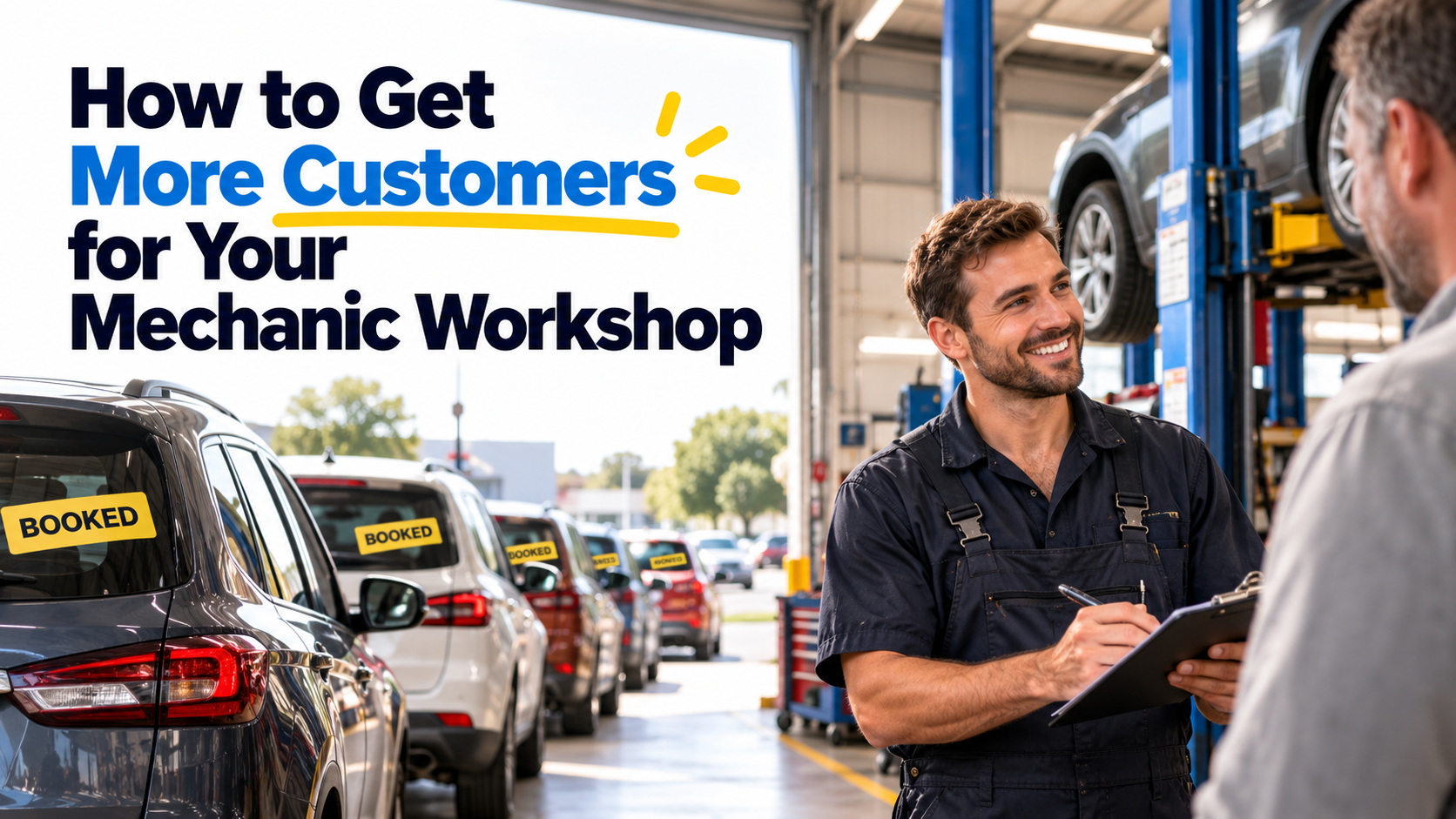
How to Get More Customers for Your Mechanic Workshop
Paid ads aren't the only way to fill your bays. Here's every real option Australian mechanics have for getting more customers, plus where each one falls short.
In this guide · 9 min read
- Why Is the Workshop Down the Road Always Full?
- What Actually Works for Getting More Workshop Customers?
- The Old Way vs the New Way: A Straight Comparison
- What Do Customers Check Before Choosing a New Mechanic?
- How Does Your Quoting Process Affect New Customer Conversion?
- The One Thing the Fully Booked Workshops Do Differently
- Frequently Asked Questions
Why does the workshop down the road stay fully booked while yours has gaps on Thursday? Same suburb. Same kind of work. No fancy ads that you can see.
If you are trying to figure out how to get more customers as a mechanic, that question is the right one. The answer is almost never paid advertising, at least not yet. And it is almost never about doing better work, because you probably already are.
It is about a handful of habits the booked-out workshops have quietly built. This post names every real option, including the ones that sound promising but waste your time, and gives you a clear picture of where each one delivers.
Why Is the Workshop Down the Road Always Full?
There is a short answer. They are easier to find, easier to trust, and easier to book than you are right now. Not because they are better. Because their process makes it effortless for a new customer to say yes.
Every tactic below is solving one of those three problems. Keep that in mind as you read.
What Actually Works for Getting More Workshop Customers?
Here are every real option, ranked roughly by return on time and money. For each one, you get what it is, where it works, and where it falls flat.
-
Google reviews, requested at the right moment
This is the single highest-leverage habit in local workshop marketing. Google's map results, the three businesses that appear before the organic listings, weight review count and recency heavily. A workshop with 60 recent reviews almost always outranks one with 15 older ones, regardless of how good the work is.
The timing matters enormously. Ask at the moment the customer collects the car, not by email two days later, not on the invoice footer nobody reads. A face-to-face ask, or a short SMS with a direct link, converts at a rate that will surprise you. Most workshops get reviews only when something goes wrong. The ones that are fully booked ask every single happy customer, every single week. -
Google Business Profile, properly filled in
Free to set up, free to update, and genuinely important. An incomplete profile with wrong hours or no photos is actively costing you customers who searched, found you, then decided you looked closed or untrustworthy.
Fill in every field. Add real photos of your workshop, your team, your equipment. Update your hours when they change. Answer the questions customers leave. This is not glamorous work. It takes about two hours once and 10 minutes a month after that. The compounding effect over 12 months is real. -
Reactivating dormant customers
Every workshop has a database of customers who came in once or twice and then went quiet. Not because they had a bad experience, usually. Because nobody followed up.
Ring five of them this week. Offer something low-stakes: a free tyre check, a safety inspection on their next service, a priority booking. Most will be pleasantly surprised that you called. This costs nothing, and the conversion rate from a warm past customer is far higher than from cold outreach or paid ads. -
Referral partnerships with complementary businesses
A smash repairer cannot do mechanical work. A tyre shop does not want to deal with brake callipers. A mobile detailer has customers who just bought a used car and need a safety check.
Pick one or two local businesses whose customers overlap with yours and have a direct conversation. Agree to send each other overflow. It does not need to be formal. A handshake and a name to call is enough. This produces some of the warmest, most pre-sold leads a workshop can get, because the referrer already did the trust-building. -
A website that actually converts
Not a complicated one. A fast-loading page that names your suburb, your services, your phone number, and has a clear way to book or enquire. That is it.
Where it falls flat is when workshops build one and never touch it again. Outdated hours, no reviews shown, no way to book online. A customer who hits a dead end at 8pm on a Sunday will book the next workshop that lets them. Online booking, even just a simple form, captures customers who will never ring during business hours. -
Social media presence
Useful, but not the priority most people think it is. Organic social for a local workshop reaches mostly people who already know you. It is better for retention than acquisition.
If you do post, show the work. A photo of a seized calliper next to a clean replacement. A before-and-after on a brake job. Real, specific content outperforms generic car tips every single time. One genuine post a week beats seven polished graphics nobody cares about. -
Paid ads (Google and Facebook)
They can work. They can also burn through a budget quickly if the foundations are not there. A workshop with 12 reviews, a slow website, and no online booking will convert paid traffic poorly.
The honest position is this. Sort your Google reviews, your profile, and your booking process first. Once those are solid, paid ads become a volume dial you can turn up when you have capacity. Used before the foundations are ready, they are an expensive way to expose weaknesses. -
Local SEO through content
Blog posts and service pages targeting local search terms, things like "logbook service [your suburb]" or "brake repair [your town]", can drive consistent organic traffic over time. The catch is that it takes six to twelve months to show meaningful results and requires ongoing effort.
For a workshop with no existing content, one well-written service page per quarter is more effective than a rushed blog post every week. Quality and specificity win over volume.
The Old Way vs the New Way: A Straight Comparison
| The old way | The new way | The real difference |
|---|---|---|
| Wait for word of mouth | Ask for a review at pickup | You stop leaving it to chance |
| Phone calls only for booking | Online booking, any hour | Customers who work nights can book |
| Paper records, no follow-up | Customer history, reactivation possible | Dormant customers become active ones |
| No referral system | One or two local partners | Warm leads that convert fast |
| Hope the website still works | Fast, mobile-friendly, bookable | No dead ends at 8pm |
What Do Customers Check Before Choosing a New Mechanic?
They check Google reviews first. Then they look at whether you are easy to contact and whether the booking process is simple. A slow reply to an online enquiry, or no way to book outside business hours, removes your workshop from consideration before you even know someone looked.
The trust problem is the real one. A new customer has no idea if you are good. Reviews and easy communication are how they decide to take the risk on someone new. Everything else is secondary.
 Read nextGoogle Reviews for Mechanics. The Real Playbook
How Does Your Quoting Process Affect New Customer Conversion?
This one surprises most workshop owners. A new customer who gets a quote by phone, with no written detail and no way to see what they are paying for, is far more likely to shop around than one who receives a clear, itemised quote they can review on their own time.
The workshops that convert enquiries well send a quote the customer can read and approve from their phone. Better still, they attach photos of the actual problem to the quote, so the customer can see the worn pad or the cracked CV boot sitting right next to the line item. No second message. No "I'll send the photos separately." The evidence lives with the price.
That is what Meckly's quoting tool does. Diagnostic images attach directly to the quote itself, visible alongside the cost, so the customer sees exactly what is wrong and exactly what it costs to fix it. One source of truth. Most platforms store images somewhere separate or require a second app. The result is fewer disputes, faster approvals, and a customer who does not feel like they are being asked to take your word for it.
And once a job is running, sourcing parts without ringing around saves the kind of time that shows up as lost hours at the end of the week. SparesIN, the auto-parts marketplace, works differently from most. A workshop posts the part it needs, and vetted local suppliers compete to fill it, integrated straight into a Meckly quote. Unlike open marketplaces, suppliers on SparesIN are verified businesses, vouched for by real workshops. Not a free-for-all. The workshop's existing payment process stays intact, and cleaner records make returns straightforward when they come up.
The One Thing the Fully Booked Workshops Do Differently
They ask. That is the short version.
They ask for the review. They ask the dormant customer to come back. They ask the smash repairer next door if they want to send each other overflow. They ask the customer to approve the quote by checking their phone.
The workshop that is quietly fully booked is not doing anything exotic. They have just built a handful of asking habits and made their process easy enough that when someone says yes, the follow-through is frictionless.
That is why the workshop down the road stays booked while yours has gaps on Thursday. Not because they do better work. Because they removed the friction between a curious customer and a confirmed booking.
Fix the friction, and the bookings follow.
Frequently Asked Questions
How do I get more customers for my mechanic workshop without spending money on ads?
The highest-return moves cost nothing upfront. Ask every happy customer for a Google review the moment they collect their car. Make sure your Google Business Profile is complete and your hours are accurate. Build one referral habit with a complementary local business. These three things compound faster than most paid campaigns.
Do Google reviews really help a mechanic workshop get found?
Yes, and the effect is bigger than most workshop owners expect. Google's local pack, the three businesses that appear on the map above organic results, is heavily weighted by review count and recency. A workshop with 60 recent reviews will almost always outrank one with 15 older ones, even if the older shop does better work.
What is the fastest free way to get a new mechanic customer this week?
Ring one customer you haven't seen in 12 months and offer them a free tyre rotation or a safety check on their next service. Most workshops have a database of dormant customers who already trust them. Reactivating one costs nothing and converts at a far higher rate than cold outreach.
Should a mechanic workshop run Facebook or Google ads to get more customers?
Paid ads can work, but they rarely work well until the foundations are solid. If your Google reviews are thin, your website is slow, or your booking process is clunky, paid traffic amplifies the problem. Fix the organic levers first, then consider ads as a volume dial, not a rescue plan.
How does a workshop get more customers through referrals?
Referrals happen naturally when the experience is easy and memorable, but you can accelerate them. Tell customers directly that referrals are the best way to support a local shop. Partner with one complementary business, a smash repairer, a tyre shop, or a mobile detailer, and agree to send each other overflow. A formal arrangement beats hoping it happens.
What do customers actually check before choosing a new mechanic?
Google reviews and star rating come first. Then they check whether the workshop has a website they can trust, whether booking is easy, and whether the shop looks responsive. A slow reply to an online enquiry, or no way to book outside business hours, eliminates many workshops before a customer ever picks up the phone.
UP NEXTGoogle Reviews for Mechanics. The Real Playbook
 Workshop tipsNew
Quote Approval by Text vs Phone. Which Gets a Faster Yes
a bay sits empty while you wait for a phone call back.
 Workshop tipsNew
Workshop KPIs Worth Checking Every Week
you can't fix what you can't see on the hoist
Workshop profitIncrease Average Repair Order Without Being Pushy
the upsell that works isn't a pitch at all