Service History Resale Value. Why It Pays
You are three minutes from agreeing on a price with a private buyer. The car is clean, it drives well, you know exactly what has been done to it. Then they ask: "Have you got the service history?" And you start describing it instead of showing it.
That moment costs Australians real money every single day. And the frustrating part is it has nothing to do with how well the car was maintained. It has everything to do with what you can prove.
Service history resale value is not a theory. Buyers pay more for documented cars, full stop. The receipt you threw out, the invoice you never saved, the logbook left blank because the workshop stamped nothing but you paid them anyway. Every one of those gaps is money leaving your pocket at the negotiating table.
Why does a service history actually change the price a buyer will pay?
Put yourself on the other side of the transaction. You are buying a five-year-old car from a stranger. You cannot see inside the engine. You cannot know whether the previous owner skipped oil changes, ran it hot, or ignored the timing chain interval. All you have is what they tell you and what they can show you.
A complete service history converts a stranger's word into documented evidence. It answers the four things every buyer is quietly worrying about.
- Was it serviced regularly? Consistent intervals at appropriate kilometres tell a buyer the previous owner was not cutting corners.
- Was the right work done? Invoices that match the manufacturer's schedule show the car received what it needed, not just what was cheapest.
- Who did the work? A reputable workshop's name and ABN on an invoice carries weight. It is verifiable.
- Are there any red flags hiding in the history? A full paper trail actually reassures buyers that there is nothing being hidden. Gaps do the opposite.
A buyer who cannot answer those questions will either walk away or discount heavily to cover the risk they are taking on. That is not them being difficult. That is rational behaviour.
How much does a missing service history cost you at sale?
The honest answer is: it depends on the car, the market and the buyer. But the directional reality is clear. Cars with a verifiable, complete service history consistently achieve higher private sale prices and better trade-in offers than equivalent cars with patchy or missing records.
Dealers and used-car buyers factor in the cost of the unknown. If they cannot verify the history, they price in the risk of an expensive repair appearing shortly after purchase. That risk discount comes straight off your asking price.
The cars hit hardest are the ones where the cost of a potential failure is high. Think timing chain engines, dual-clutch transmissions, turbocharged vehicles, and anything approaching a major service interval. If you cannot show the buyer it was done, they will assume the worst and price accordingly.
The old way vs the documented way
| Situation at sale | What the buyer sees | What it does to the price |
|---|---|---|
| Stamped logbook only | Evidence of regular servicing but no detail on what was done | Better than nothing, but serious buyers still want invoices |
| Invoices only, no logbook | Detail on work done but gaps in the timeline are possible | Reasonable, especially if invoices are complete and sequential |
| Full logbook plus all invoices | Complete, verifiable, cross-referenced record | Strongest position, buyers pay and negotiate least |
| Nothing, or "I've got them somewhere" | Uncertainty and risk | Price drops to compensate for the unknown |
Does the service have to be done at a dealer to count?
This is one of the most persistent myths in Australian car ownership, and it genuinely costs people money in two directions. First, they overpay for dealer servicing to protect resale value they could have protected any other way. Second, they skip services at independent workshops because they wrongly believe it will hurt them.
Under Australian Consumer Law, having your car serviced by an independent workshop does not void your new-car warranty, provided the service meets the manufacturer's specification. The ACCC has been clear on this. What matters is that the work is done correctly and documented properly. The badge above the door is irrelevant. Always verify your specific situation with the relevant authority or a legal adviser, because circumstances vary.
The genuine insight here is this: an independent workshop that issues you a detailed invoice is more useful at resale than a dealer service with no paperwork trail beyond a stamp. Documentation beats brand every time.
The three things buyers actually check
When a thorough buyer sits down with your service history, they are looking at three things in particular.
- Kilometre consistency. Do the service intervals make sense for how the car was driven? Big gaps between services at low kilometres can suggest the car sat unused, which raises its own questions about seals, tyres and fluids degrading with age rather than use.
- Major items completed. Timing belt or chain, brake fluid, transmission service, spark plugs. If the car is at the age or kilometre mark where these should have been done and there is no record, buyers will factor in the cost of doing them immediately.
- The same workshop, repeatedly. A car that has been to the same workshop multiple times tells a story of an owner who was engaged with maintenance, not just running the car until something fell off.
What to do if your records are incomplete right now
Start with what you have. Ring every workshop that has serviced the car and ask for copies of old invoices. Most workshops keep records for years and will email them to you. It takes one phone call per workshop.
From today forward, the job is simple: keep every invoice the moment you receive it. Not in a shoebox. Not in your email somewhere. In a place you can actually find them and show them to a buyer in under two minutes.
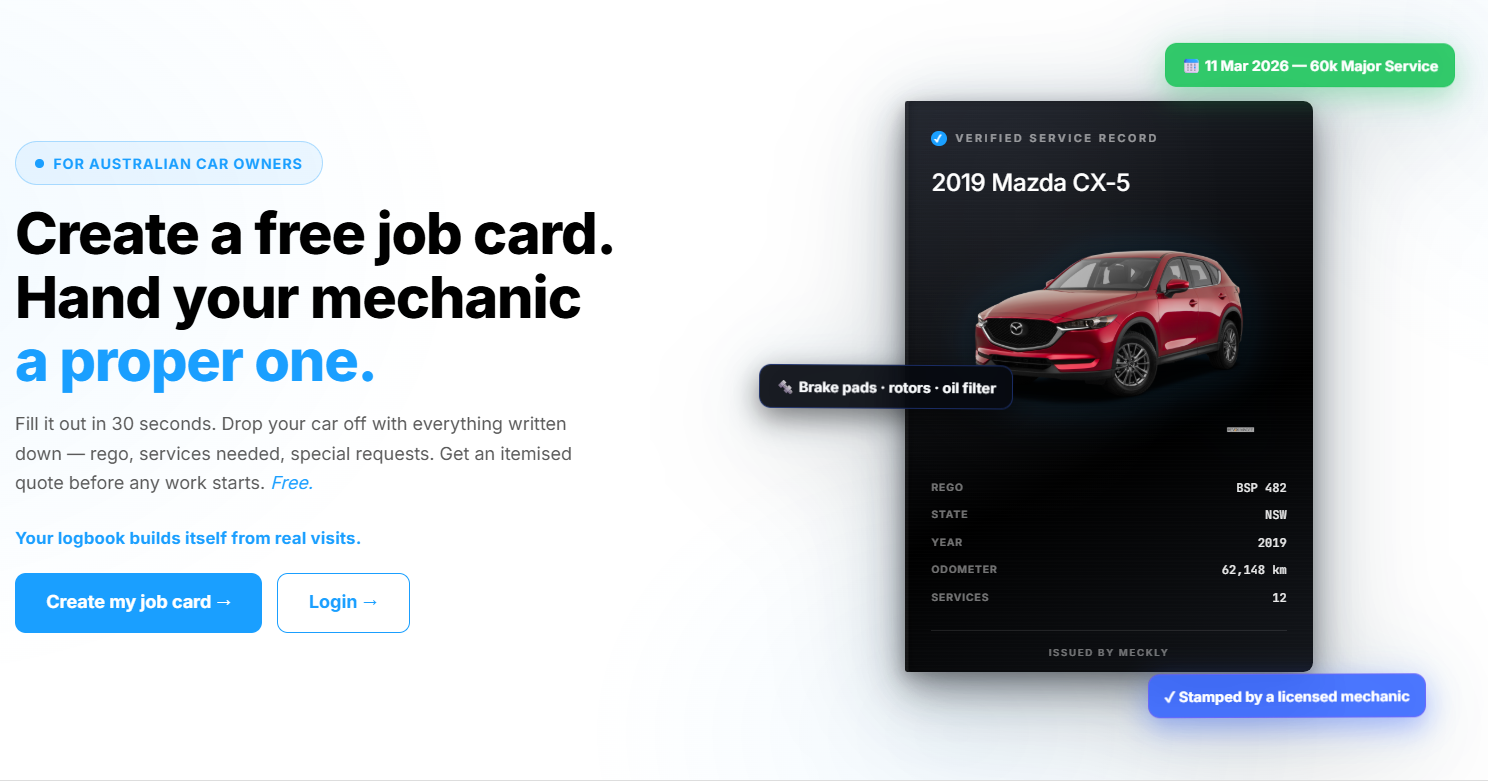
That is exactly what Meckly MyFleet is built for. It is free for car owners, covers every vehicle in your household in one account, and stores every service invoice in one place so you are never describing your history instead of showing it. When a buyer asks the question, you hand them the screen.
Frequently asked questions about service history and resale value
Does a full service history really increase resale value in Australia?
Yes, consistently. Buyers and dealers use service history to assess risk, and a car with complete records is seen as a lower-risk purchase. The gap between a fully documented car and one with patchy history can run into hundreds or thousands of dollars depending on the vehicle's age and value.
What counts as a full service history in Australia?
A full service history typically means a dated record of every scheduled service, with invoices or stamped logbook entries showing what was done, by whom, and when. Ideally you have both the logbook and the actual invoices. One without the other is less convincing to a serious buyer.
Does the service history need to be from a dealer or franchise workshop?
No. Under Australian Consumer Law, having your car serviced at an independent workshop does not void your new-car warranty, provided the service is carried out to the manufacturer's specification and proper records are kept. The key is documentation, not the badge above the workshop door.
What if I've lost some of my service invoices?
Contact the workshops that serviced the car and ask for copies. Most will have records on file, sometimes going back years. Going forward, the simplest fix is storing every invoice digitally as soon as you receive it, so you are never hunting through a shoebox again.
How do I prove service history to a private buyer?
Show them dated invoices that match the odometer readings in your logbook, or a digital record they can scroll through. The more detail the better: parts replaced, fluids used, work performed. A buyer who can see a consistent pattern of genuine care will pay more and negotiate less.
Do electric and hybrid vehicles need a service history too?
Yes. EVs and hybrids still require scheduled maintenance, tyre rotations, brake inspections, cabin filter changes and battery health checks. Buyers of these vehicles are often just as thorough, sometimes more so, because the cost of an unknown battery issue is significant. Good records matter just as much.
The receipt you threw out is costing you thousands. Not because the service was not done. Because the proof is gone. That is the only part of this problem that is entirely fixable, and it costs nothing to fix it today.