
Mechanic Tax Invoice Requirements. ATO Rules Explained
One missing field on a tax invoice and the ATO can treat the whole thing as non-compliant. Here's exactly what has to be on every mechanic tax invoice, and why most shops are one audit away from a headache.
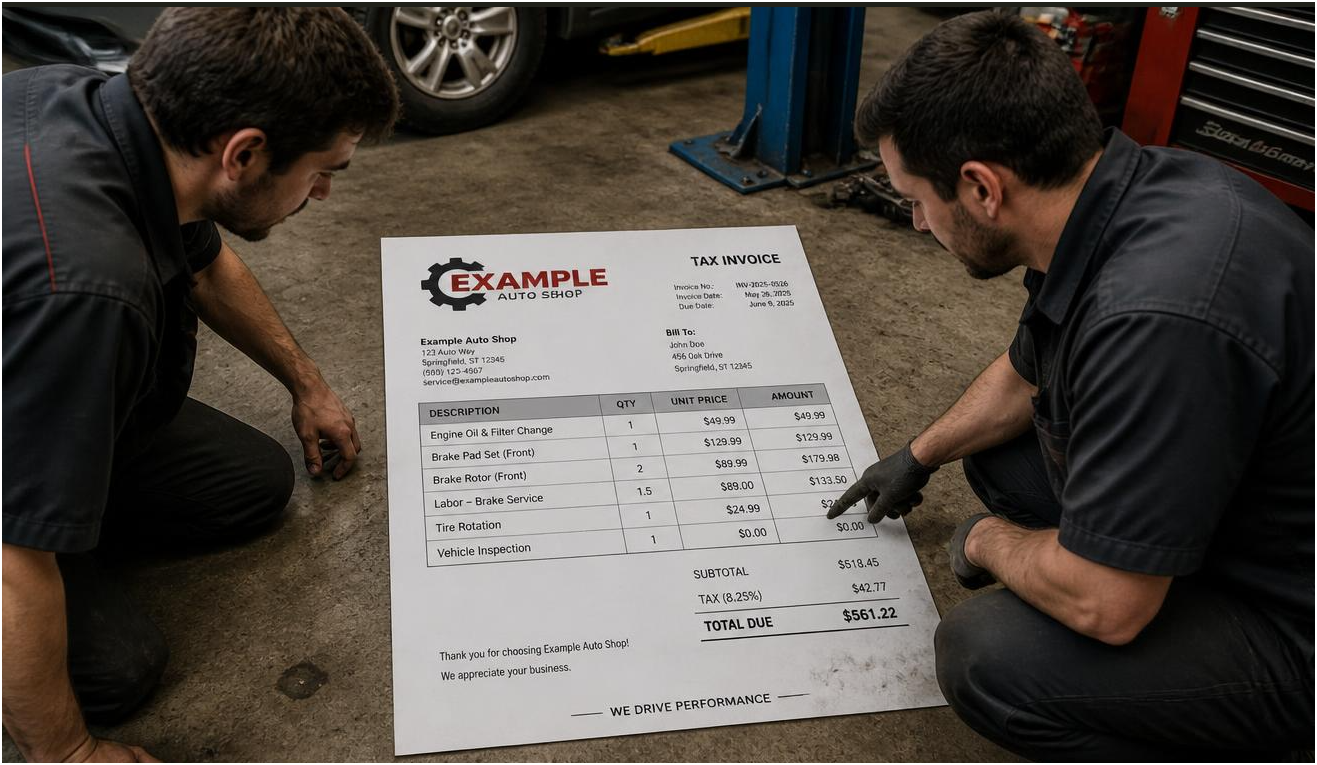
In this guide · 9 min read
- What does the ATO actually require on a mechanic tax invoice?
- What's the $82.50 rule every workshop should know?
- Where do most mechanic invoices fall short?
- Should parts and labour be itemised separately?
- The old way versus a compliant invoice: a plain comparison
- Can a digital invoice satisfy ATO requirements?
- How does the right software make this automatic?
- Frequently asked questions about mechanic tax invoice requirements
A GST credit that your customer cannot claim. A BAS that gets queried. An audit where your own invoices become the problem. None of those start with a big mistake. They start with one field left off a document you issued a thousand times and never thought twice about.
That is the quiet risk hiding in mechanic tax invoice requirements. Not the dramatic stuff. The ordinary invoice you send after every job, which may have been missing a mandatory field since the day you opened.
Here is every field the ATO actually requires, where most workshops fall short, and what a clean invoice looks like in practice. Attribute all rules below to the ATO and confirm specifics with your accountant, because your situation may vary.
What does the ATO actually require on a mechanic tax invoice?
According to the ATO's published guidance on tax invoices, a valid tax invoice for a GST-registered business must include all of the following.
- The words "Tax Invoice" displayed clearly. Not just "Invoice". Not "Receipt". The ATO is specific: the document must be identified as a tax invoice. This is the one most templates get quietly wrong.
- Your business name. The legal or trading name of the entity registered for GST.
- Your ABN. No ABN, no valid tax invoice. Full stop.
- The date of issue. The day the invoice was created and sent, not the day the work was done if those differ.
- A description of each thing you supplied. The ATO requires that the goods or services be described. "Labour" is thin. "Replace front brake pads and rotors, road test" is what a compliant description looks like.
- The GST amount, or a statement that the price includes GST. You can show the GST as a separate line, or you can include a statement like "Total price includes GST of $X". Either works. Silence does not.
- The total amount payable. The full price the customer owes.
- For invoices over $1,000 (including GST), the recipient's identity. Their name and address, or ABN if they are a business. Below $1,000 this is not required, but above it, the ATO treats an invoice without it as non-compliant.
That is the complete list, as stated by the ATO. Eight fields. Miss one and a business customer generally cannot claim a GST credit from it. Miss one in an audit and the conversation gets longer than you want.
What's the $82.50 rule every workshop should know?
The ATO states clearly: if a customer asks for a tax invoice, you must provide one within 28 days, unless the sale is for $82.50 including GST or less.
That 28-day window is not a suggestion. It is the ATO's rule. A customer who asks and does not receive a compliant invoice within 28 days has legitimate grounds to escalate. In a trade where reputation travels fast, that is a problem worth avoiding.
Practically, that threshold of $82.50 means almost every mechanical repair will require a tax invoice on request. Most workshops should be treating every job as requiring one regardless, which removes the decision entirely and keeps your records clean.
Where do most mechanic invoices fall short?
The common failures are not dramatic. They are small, repeated, invisible until they matter.
- Missing "Tax Invoice" wording. A generic template downloaded from somewhere that says "Invoice" at the top. Technically non-compliant under ATO rules.
- Vague descriptions. "Parts" is not a description. "Labour" covers nothing. The ATO requires each thing supplied to be described. So does your customer when they dispute a line item six months later.
- GST not shown or stated. If the GST is bundled into a total with no mention, the invoice is not compliant. Show it separately or state it explicitly.
- No ABN. Rarer, but it happens on handwritten or rushed invoices, especially for small cash jobs.
- Over-$1,000 invoices missing the recipient's name and address. This one catches workshops out most often on fleet and commercial accounts.
Should parts and labour be itemised separately?
The ATO does not specifically mandate separate line items for parts and labour. The requirement is a description of each good or service supplied.
In practice, separate itemisation protects you in several ways.
- Under Australian Consumer Law, a customer is generally entitled to know what they paid for. Bundling parts and labour into a single line makes that harder to demonstrate.
- A dispute about parts markup or labour rate is much easier to resolve when both are visible. A bundled total invites argument.
- Business customers reconciling GST credits need to see what was supplied. Separate lines make that easier for them and reflect better on you.
Itemise. It costs nothing and pays for itself the first time someone pushes back on a bill.
 Read nextGoogle Reviews for Mechanics. The Real Playbook
The old way versus a compliant invoice: a plain comparison
| Field | Typical rushed invoice | ATO-compliant invoice |
|---|---|---|
| Document heading | "Invoice" | "Tax Invoice" |
| Business identity | Name only, no ABN | Name and ABN |
| Description of work | "Parts and labour" | Each item described separately |
| GST treatment | Total only, GST not mentioned | GST shown or stated explicitly |
| Recipient (over $1,000) | Not included | Name and address or ABN |
| Date | Sometimes missing | Date of issue always present |
Verdict: the compliant version takes the same number of seconds if your system is set up right. The difference is entirely in the template and the habit.
Can a digital invoice satisfy ATO requirements?
Yes. The ATO accepts digital tax invoices, including those sent by email or generated through software, as long as every required field is present. The medium is irrelevant. The content is everything.
This matters for mobile mechanics especially. An invoice sent from a phone on the customer's driveway is fully compliant if it contains the right fields. Paper is not required.
How does the right software make this automatic?
Here is where the process either works for you or against you. Setting up a compliant template once and letting it generate every invoice removes the human error that creates the compliance problem in the first place.
One missing field on a tax invoice and the ATO can reject the whole invoice. That is not a reader problem or a knowledge problem. It is a system problem. The workshops that get this right are not necessarily more careful, they just have a tool that handles it without thinking.
Meckly's mechanic invoice software generates GST-compliant tax invoices with every required ATO field built into the template. The ABN is there. The "Tax Invoice" heading is there. The GST line is there. Line items with descriptions are the default, not the exception. What also makes it practical in a dispute is that diagnostic images are saved directly on the quote itself, not in a separate folder or a second app. The photo of the worn component sits right next to the line item and the price the customer approved. One source of truth. The evidence and the cost are in the same place, which matters the moment anyone asks why a job was done.
Parts records tie in cleanly as well. SparesIN, the auto-parts marketplace integrated into Meckly, is where workshops post the part they need and vetted local suppliers compete to fill it. Unlike a general marketplace, SparesIN is not open to anyone with a part to sell. Suppliers are verified businesses, vouched for by real workshops. It is properly business-to-business. That means the parts trail on an invoice reflects a real, traceable supply chain, which is exactly what clean records look like when an audit or a return comes up. It does not change how a workshop pays or collects. It just means the paperwork behind each line item is solid.
The eight fields on a compliant tax invoice are not complicated. They never were. The only reason they cause problems is that nobody built them into the process from the start.
Fix the template. Fix the habit. The invoice becomes the least stressful part of the job.
Frequently asked questions about mechanic tax invoice requirements
What must be on a mechanic tax invoice under ATO rules?
Under ATO rules, a tax invoice for a GST-registered workshop must include the words "Tax Invoice", the supplier's name and ABN, the date of issue, a description of each good or service supplied, the total price, and the GST amount shown separately (or a statement that the total includes GST). For invoices over $1,000, the recipient's name and address are also required. Check the ATO's own guidance for the current rules as they apply to your situation, and confirm specifics with your accountant.
Do I have to issue a tax invoice if a customer doesn't ask for one?
Under ATO rules, you must provide a tax invoice within 28 days if a customer requests one, for any taxable sale over $82.50 including GST. The ATO's published guidance states this clearly. Whether you must issue one unprompted depends on your business setup, so confirm the obligation with your accountant or BAS agent.
Does the $82.50 threshold apply to parts and labour combined or separately?
The $82.50 threshold applies to the total sale, meaning parts and labour combined on a single invoice. If the total taxable sale exceeds $82.50 including GST and the customer requests a tax invoice, you must provide one within 28 days. Verify this with your accountant for your specific circumstances.
What happens if I issue an invoice without all required fields?
An invoice missing required fields is generally not considered a valid tax invoice under ATO rules. This means a business customer cannot use it to claim a GST credit. It may also create compliance issues for your workshop if audited. Getting the format right from the start saves significant trouble later.
Does a mechanic invoice need to itemise parts and labour separately?
The ATO does not specifically require parts and labour to appear as separate line items, but a clear description of each good or service supplied is required. In practice, itemising parts and labour separately protects you under Australian Consumer Law and reduces customer disputes over what they paid for. Most accountants and industry bodies recommend it.
Can I use a digital or emailed tax invoice instead of paper?
Yes. The ATO accepts digital tax invoices, including emailed or app-generated ones, as long as they contain all required fields. The format does not need to be paper. What matters is that the document meets the content requirements and can be retrieved if needed for an audit or dispute.
UP NEXTGoogle Reviews for Mechanics. The Real Playbook
 Workshop growthNew
How to Get More Customers for Your Mechanic Workshop
why does the workshop down the road stay fully booked?
 Workshop tipsNew
Quote Approval by Text vs Phone. Which Gets a Faster Yes
a bay sits empty while you wait for a phone call back.
 Workshop tipsNew
Workshop KPIs Worth Checking Every Week
you can't fix what you can't see on the hoist