Why Mechanics Quote Parts Before Checking Availability
You approve a quote, then wait. The part wasn't actually in stock. Here's why that happens, why it's not your mechanic's fault, and what you can do about it.
In this guide · 7 min read
The quote arrived. The part didn't.
You gave the workshop the go-ahead on a Tuesday afternoon. They told you the car would be ready Thursday. Thursday came and went. Then Friday. Then a message: the part is on back-order, it'll be in Monday, maybe Tuesday.
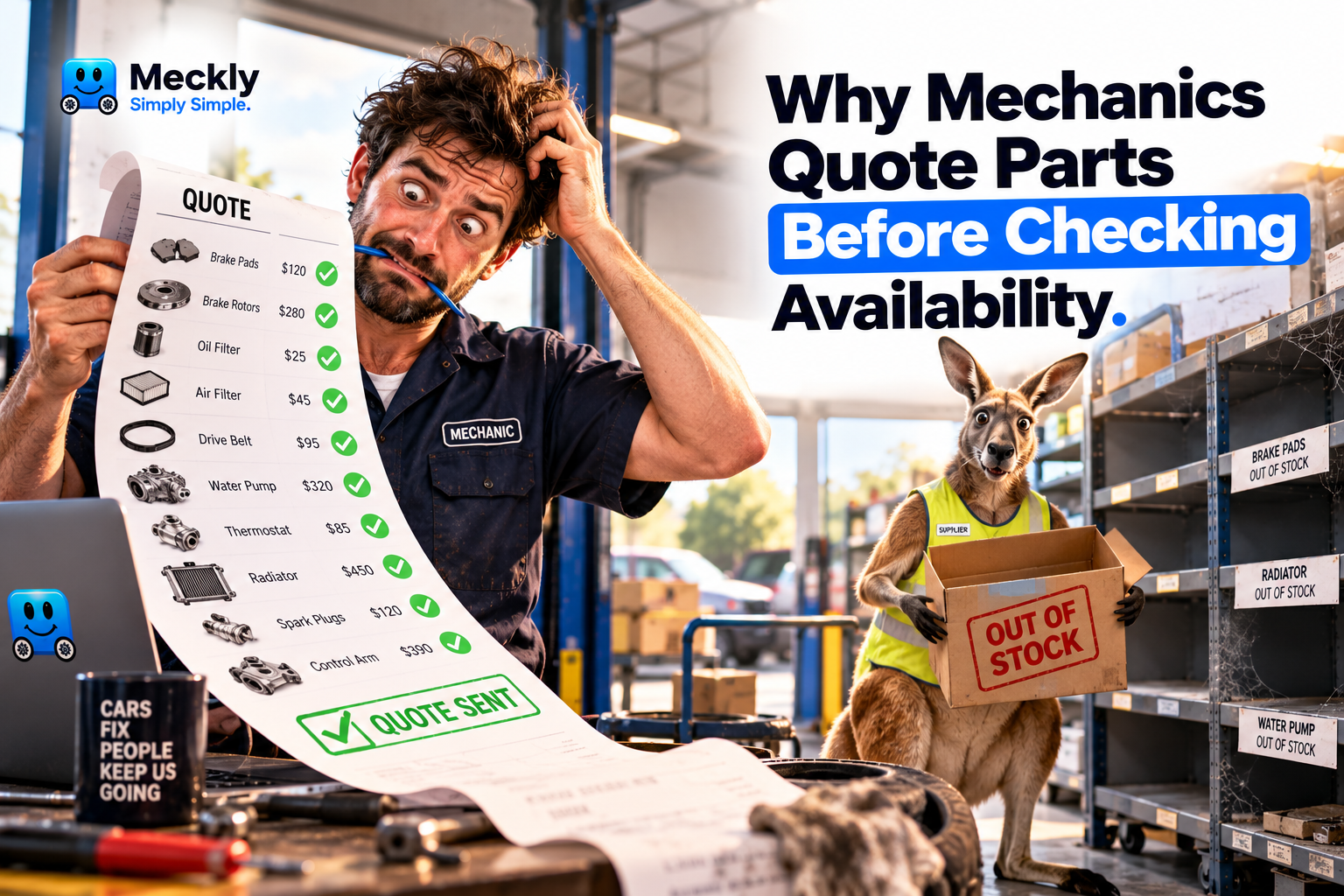
You were not lied to. But you were quoted on something that was never actually confirmed to exist. That is the mechanic parts availability quote delay, and it happens to Australian car owners constantly. Not because workshops are disorganised, but because of the way the industry's systems are built.
Why Does a Mechanic Quote Parts Before Confirming Availability?
Here is what actually happens between your mechanic's diagnosis and your inbox.
The mechanic identifies the fault, looks up the part in a catalogue, assigns a standard price, and builds a quote. That catalogue is not a live inventory system. It is a list of part numbers and reference prices drawn from supplier data that may have been updated days or weeks ago.
The quote lands with you. You approve it. Then, and only then in many workshops, someone rings the supplier to actually order the part.
That is when the real availability picture arrives.
The process is the problem here, not your mechanic. They are working with two systems that do not talk to each other. One tells them what a part costs. The other tells them whether it exists on a shelf within a useful radius. Those two systems are almost never the same system.
What Does That Delay Actually Cost You?
A day's delay on a second car is an inconvenience. A day's delay on your only vehicle, when you have school runs, a job site to reach, or a hundred kilometres of highway between you and work, is a genuine problem.
The cost shows up in four ways.
- Time off the road. Every day the car sits waiting for a part is a day you are making other arrangements.
- Unexpected hire car costs. If you need a rental, that is a bill nobody quoted you.
- Revised pricing. Parts prices move. A supplier quote that was valid on Tuesday may not be the same number on Monday the following week. Under Australian Consumer Law, a business generally cannot charge more than an accepted quote without your agreement, but a delay caused by a back-order can create a legitimate reason to reopen the conversation. Check the ACCC's guidance if you find yourself in that position.
- Lost trust. This one is quieter but it matters. A customer who feels like they were given a guess dressed up as a quote does not come back.
The Old Way vs the New Way: How Parts Sourcing Actually Works
Understanding the landscape helps you ask better questions before you hand your keys over.
| Method | How it works | Where it falls short |
|---|---|---|
| Phone around | The workshop calls two or three regular trade suppliers | You hear from whoever picks up first, not whoever has the best price or fastest stock |
| Supplier online catalogue | Workshop logs into a supplier portal and checks stock | Each portal is separate, prices vary, stock data can lag real warehouse levels |
| Single preferred supplier account | One supplier, one call, familiar credit terms | If that supplier is out of stock, you start again from zero |
| Parts marketplace | Workshop posts the part, suppliers respond with price and availability | Quality of suppliers varies widely unless the platform vets who can participate |
The first three methods all share one flaw. The workshop is doing the chasing. They ring out, wait, follow up, and piece together a picture of the market one call at a time. Meanwhile your car sits still.
The fourth option flips that. Instead of the workshop hunting for a part, the part hunt comes to them. Suppliers compete to fill the order with real stock and a real price. The mechanic picks the best option rather than taking the first available one.
That is the design behind SparesIN, the auto-parts marketplace. A workshop posts the part it needs and vetted local suppliers compete to fill it, integrated straight into their quoting workflow. Unlike most marketplaces, SparesIN is not open to anyone with a part to sell. Suppliers are verified trade businesses, vouched for by other real workshops. It is properly business-to-business, not a free-for-all. The way the workshop pays and collects stays exactly the same. It just means cleaner records, faster confirmation, and a quote price that reflects what a part actually costs today, not what a catalogue said last month.
 Read nextTrack Car Parts Costs Across Multiple Vehicles
How to Ask Better Questions Before You Approve a Quote
You cannot fix the system. But you can protect yourself from the worst of it.
Before you approve any quote, ask these three things.
- Is this part confirmed in stock with your supplier? A good workshop will not take offence. If they have not checked yet, this prompts them to do it before you commit.
- What is the realistic ready date, not the optimistic one? Ask them to assume one thing goes slightly wrong. Build that into your planning.
- Will the price hold if there is a delay? Supplier prices can shift on back-ordered parts. Knowing the workshop's policy upfront avoids a tense conversation later.
None of these are aggressive questions. Any workshop worth returning to will answer them straight.
Why Your Service History Matters Here Too
There is a quieter benefit to keeping proper records across your car's life, and it connects directly to parts delays.
When a workshop can see your car's full service history, including which parts were fitted, when, and at what mileage, they can anticipate what is likely coming at the next service. A mechanic who knows your brake pads were at 4mm eighteen months ago can order ahead of your next visit rather than sourcing on the day. That preparation turns a potential delay into a same-day job.
The problem is that most Australians' service records are scattered. Each workshop keeps their own records in their own system. You might have three shops' worth of history sitting in three separate places you cannot access.
That is the gap Meckly closes. Using Meckly with any workshop is free for the car owner, no charge ever for that shop's records. Meckly Fleet is the separate upgrade that adds a specific car so its full service history, and every invoice from every workshop it has visited, becomes visible in one searchable place instead of scattered across systems. If you run a couple of cars in a household or a small business keeps a few vehicles on the road, being able to pull up any vehicle's complete history in thirty seconds is genuinely useful, especially when you are trying to plan ahead or when resale time comes.
Frequently Asked Questions
Why does my mechanic send a quote before confirming the part is in stock?
Most workshop software separates quoting from parts ordering. A mechanic diagnoses the fault, builds the quote using a catalogue price, and sends it for your approval before they have confirmed real-time stock with a supplier. It is not laziness. It is how the two systems are designed, and they rarely talk to each other.
How long does mechanic parts availability delay usually add to a repair?
A same-day part from a local trade supplier adds nothing. A part that needs to come from a capital city warehouse typically adds one to two business days. Imported or low-volume parts can take one to three weeks. The delay is almost never the labour. It is always the supply chain sitting between the quote and the car.
Can I ask my mechanic to confirm parts availability before quoting?
Yes, and a good workshop will not mind you asking. The honest answer is that confirming stock before quoting adds time to the diagnostic step, and some workshops charge a small diagnostic or inspection fee to cover that work. That is fair. What you get in return is a quote where the price and the timeline are both real.
What should I do if a quoted part price changes after I approve the quote?
Under Australian Consumer Law, a business generally cannot charge more than a quoted price without your agreement. If the price changes due to stock unavailability, the workshop should contact you before proceeding. Ask for any price change in writing and confirm the revised total before you authorise the work. Check the ACCC's guidance on quotes and estimates at accc.gov.au if you are unsure of your rights.
Does keeping my service records help with parts availability delays in future?
It can. When a workshop has your car's full service history, including which parts were fitted and when, they can anticipate what is likely to need replacing at the next visit and order ahead. That preparation is easier when records live in one place rather than spread across multiple workshops' systems.
The quote arrived. Now you know exactly why the part took longer to follow.
UP NEXTTrack Car Parts Costs Across Multiple Vehicles
 Car ownership
Service Reminders for a Small Fleet. The Right Way
one missed service, and the whole fleet slips.
 Car ownership
Car Expenses Tax Claim Australia. What You Can Actually Claim
Most of that $10.6 billion never gets claimed at all.
 Car ownership
Digital Service Record Trade-In Value. The Real Number
the most expensive invoice is the one you can't find