Sole Trader Mechanic. Cut Admin, Keep More Time
Three to five hours a day on paperwork is not the cost of running a workshop. It's the cost of running the wrong systems. Here's how to fix that.
In this guide · 8 min read
- Why does admin eat so much time in a sole trader workshop?
- What are the real options for sole trader mechanic reduce admin goals?
- The old way vs the new way: a plain comparison
- How do you actually build a leaner admin stack?
- What about the things admin software cannot fix?
- Frequently asked questions
- The real measure
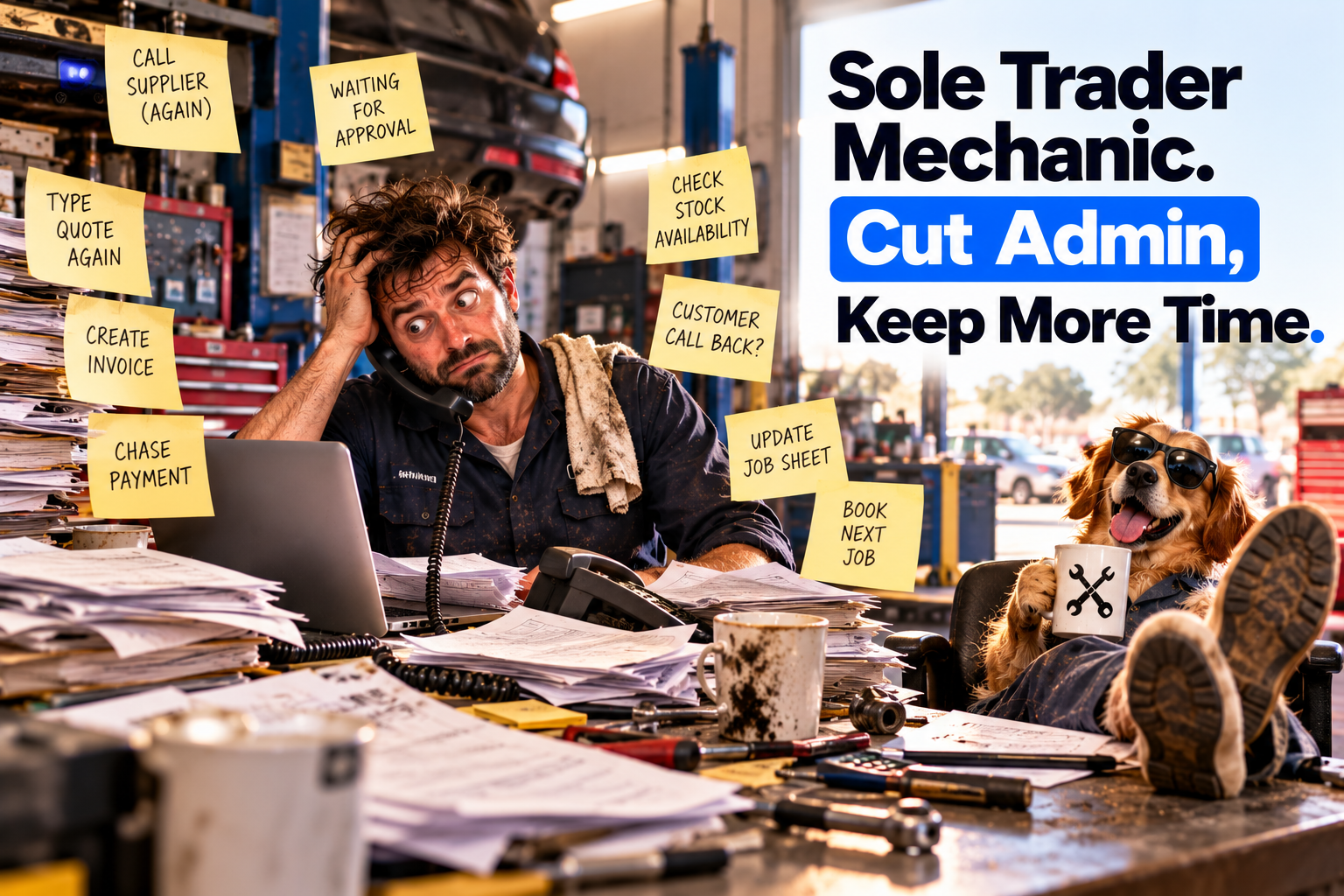
Add up every minute you spent last week that had nothing to do with fixing a car. Phone calls chasing parts. Typing up the same job twice because the quote sheet and the invoice live in different places. Waiting for a customer to ring back and approve something before the bay can move. Most sole trader mechanics who go through this exercise land somewhere between three and five hours a day. That is not the cost of running a workshop. It is the cost of running the wrong systems. Your slowest job this week had nothing to do with the car.
There is a way out. It is not one magic tool. It is a stack of small decisions that collapse the admin into something a single-person workshop can actually manage. Here is the honest landscape, including the parts that compete with each other.
Why does admin eat so much time in a sole trader workshop?
The problem is not that you have paperwork. Every business does. The problem is that most workshops run four or five separate processes that should be one. A job card in one place, a quote in another, a parts order over the phone, a photo on your personal phone, and an invoice typed up from scratch at the end. Each step is fine on its own. Together, they mean you touch every job five or six times before it closes.
For a sole trader there is no admin person to absorb that. It all lands on you, usually between jobs, usually under time pressure. The process is the villain here, not you.
What are the real options for sole trader mechanic reduce admin goals?
Here are the main approaches workshops use, and where each one honestly falls short.
- Spreadsheets and paper job cards. Free, familiar, no subscription. Fails because nothing talks to anything else. You re-key data at every stage, there is no audit trail a customer can see, and chasing unpaid invoices means rifling through a folder.
- Accounting software alone (Xero, MYOB, QuickBooks). Good for the ATO side of your life. The ATO's rule is that sole traders must keep records for at least five years, and these tools make that straightforward. Where they fall short is the workshop floor: no job cards, no quote-to-approval flow, no parts integration. You still need something else for the day-to-day.
- Generic small-business CRM tools. Designed for service businesses in general. They can handle bookings and invoices but they do not understand automotive workflows, part numbers, labour times, or how a quote needs to look when a customer is staring at a bill they did not expect.
- Workshop management software. Built for mechanics specifically. Handles job cards, quotes, approvals, parts, invoicing, and customer history in one place. The honest downside is that most of them require setup time upfront and a monthly cost. Some also store photos separately from quotes, which means you still end up with evidence in one place and the price in another when a dispute comes up.
- Ringing around for parts. Still the default for most workshops. It works until it doesn't. Five calls, three voicemails, one bloke who never rang back, for one brake disc. Nobody invoices for that time. It just quietly disappears from your day.
The old way vs the new way: a plain comparison
| Task | Old way | New way |
|---|---|---|
| Parts sourcing | Ring three suppliers, leave voicemails, wait | Post the part, suppliers respond with prices |
| Quote approval | Print or read out over the phone, wait for a callback | Digital quote, one-tap approval on the customer's phone |
| Job photos | Taken on personal phone, sent separately or lost | Saved directly on the quote, customer sees fault and price together |
| Invoice | Retyped from job card or quote | Generated from the approved quote, no re-entry |
| Records for tax | Folder of receipts, exported spreadsheet | Everything timestamped and searchable in one system |
The verdict is simple. The old way is not wrong, it is just expensive in time. And time is the one thing a sole trader cannot buy back.
How do you actually build a leaner admin stack?
Start with the three areas that cost you the most hours, and fix them in order.
1. Parts sourcing
Stop treating this as a phone task. SparesIN, the auto-parts marketplace, flips the model: you post the part you need, and vetted local suppliers compete to fill it. Unlike open marketplaces it is not a free-for-all. Suppliers are verified businesses, vouched for by real workshops, so it stays properly business-to-business. It integrates straight into a Meckly quote, so the part price lands in the right line item without you typing it twice. Your existing payment and collection process does not change, and returns are easier because the record is clean from the start.
2. Quotes and approvals
Under Australian Consumer Law, as a general rule you need a customer's authorisation before starting work. That is not just a legal box. It is your protection when someone disputes a bill. A digital quote the customer can approve on their phone, with a timestamp, gives you that record automatically. No more waiting by the phone. No more bays sitting idle because someone hasn't called back yet.
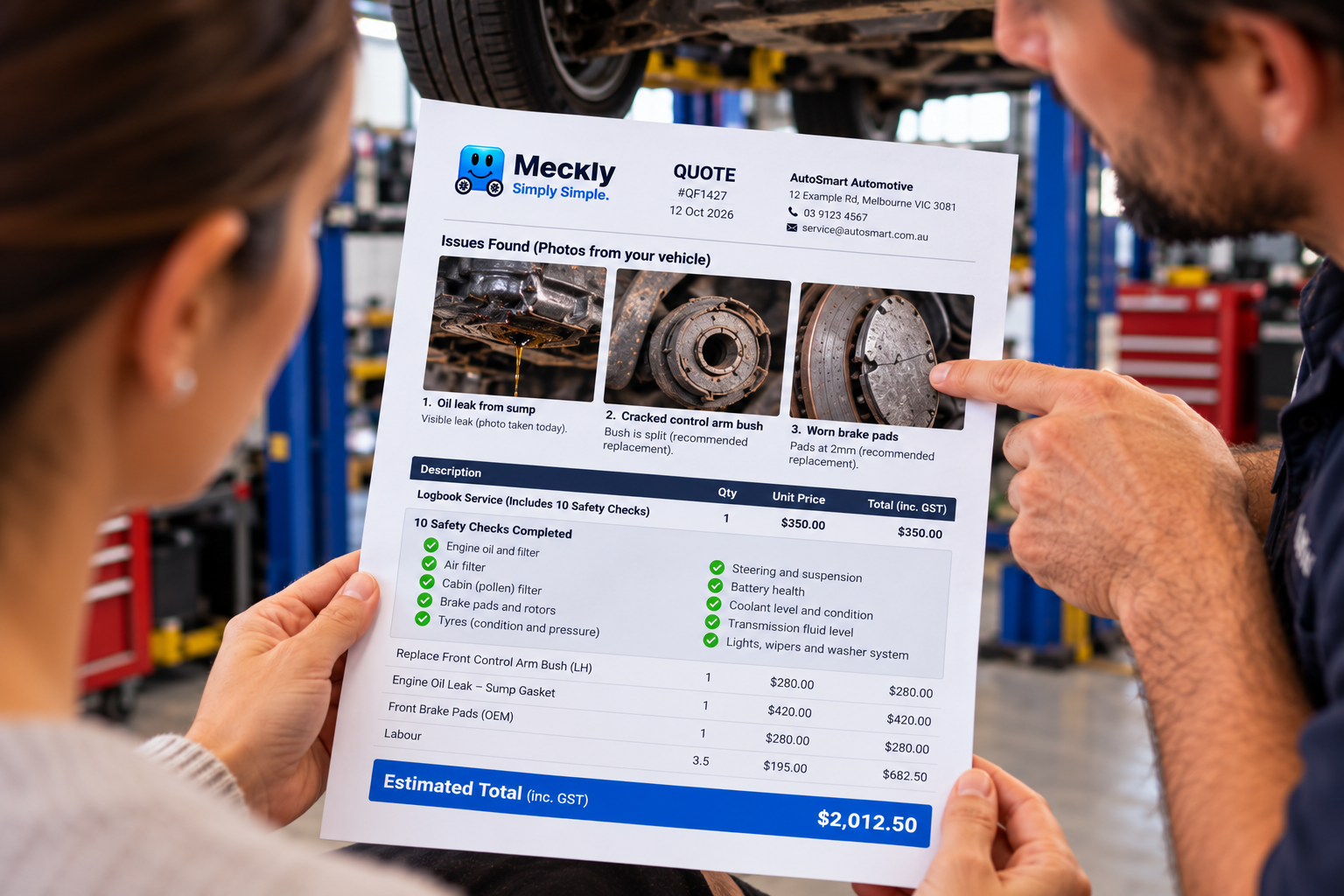
Here is the part most workshops do not know: when the photo of the problem lives on the quote itself, next to the line item and the price the customer approved, disputes drop sharply. Most platforms store images in a separate folder or need a second app. Meckly keeps diagnostic images directly on the quote, so there is one source of truth. The customer sees what is wrong attached to what it costs. That builds trust before the bill arrives, not after.
3. Invoicing and records
If your quote and your invoice are two separate documents you are doing the same job twice. A system where the approved quote becomes the invoice, automatically, removes that entirely. Pair it with accounting software connected to your bank and the ATO side largely runs itself. Check with your accountant about GST reporting obligations for your turnover level, because the rules differ depending on where you sit.
Digital Job Cards Cut Six Phone Calls to OneRead nextDigital Job Cards Cut Six Phone Calls to OneWhat about the things admin software cannot fix?
A few things are worth naming honestly.
- Software does not chase a customer who genuinely will not pay. Clear written terms upfront, as Sprintlaw notes for mechanic businesses, reduce disputes and speed up payment more than any tool.
- A booking system only helps if customers use it. Some demographics still prefer ringing. Build the digital option, but keep the phone line.
- None of this replaces a good accountant for end-of-year obligations. Use the tools to feed them clean data, not to replace their judgement.
Frequently asked questions
How can a sole trader mechanic reduce admin time each day?
The biggest wins come from collapsing separate tools into one. Quotes, approvals, parts sourcing and invoices handled in the same system mean you stop re-entering the same job three times. Digital approvals alone remove a full phone call per job.
Do I need accounting software as a sole trader workshop owner?
Generally yes, because the ATO requires sole traders to keep records of income and expenses for at least five years. Software like Xero or MYOB connects to your bank and auto-categorises most transactions. Check with your accountant about what suits your turnover and GST obligations.
What is the best way to get parts quotes without ringing around?
Posting the part you need to a marketplace where vetted suppliers compete to fill it saves the most time. SparesIN, the auto-parts marketplace, works this way: you post the part, local verified suppliers respond with prices, and it connects directly into your quote. No phone queues, no voicemails.
How do I get customers to approve quotes faster?
Send a digital quote the customer can approve on their phone with one tap. The quicker a customer can say yes without having to ring you back, the faster the bay turns. Attaching photos of the fault to the quote itself also reduces the back-and-forth because the customer can see exactly what they are approving.
Is it worth using workshop management software as a sole trader?
For most sole traders the break-even is fast. If you spend two or more hours a day on admin, a system that halves that pays for itself in recovered billable time within weeks. The bigger gain is fewer errors, fewer disputes, and a cleaner paper trail if the ATO ever asks.
How do I reduce customer disputes over invoices as a mechanic?
The dispute usually starts with bill shock, and bill shock usually starts with a quote the customer didn't fully understand. Sending a quote with photos of the problem attached, so the customer sees what is wrong next to what it costs, removes most of the surprise. Under Australian Consumer Law you generally need authorisation before starting work, so a documented digital approval protects you either way.
The real measure
Most sole trader mechanics who tighten their admin stack do not notice it as a single dramatic change. They notice it as a Tuesday where they knocked off on time. A Friday where the invoices were already sent. A customer who approved a quote in twenty minutes because they could see the cracked CV boot in the photo right next to the price, and they understood exactly what they were paying for.
That is the loop that opened at the start of this post. Those three to five daily hours are not gone because you worked harder. They are gone because the process stopped being the thing that ran your day. Meckly's free onboarding is a good place to start if you want to see how it fits a single-person workshop.
Digital Job Cards Cut Six Phone Calls to One
 WorkshopsNew
Quote Approval Delays. What a Silent Bay Costs
 Workshop tipsNew
How to Explain a Repair Recommendation Customers Trust
the customer didn't distrust the price. They distrusted the explanation.
 Workshop tipsNew
Why Your Busiest Day Kills Workshop Productivity
your busiest day and your most profitable rarely match.