Why Your Busiest Day Kills Workshop Productivity
A full book and a ringing phone feels like winning. It isn't always. Here's the uncomfortable truth about why workshop productivity slow cash flow problems peak on your busiest days.

In this guide · 7 min read
- Why Does a Full Book Feel Like Profit But Sometimes Isn't?
- What Is Actually Eating Your Profitable Hours?
- The Old Way vs The Better Way: A Straight Comparison
- Why Parts Sourcing Is the Biggest Single Drain
- The Quote Approval Problem Nobody Talks About
- Closing the Loop: What a Fixed Day Actually Looks Like
- Frequently Asked Questions
Add up every minute you spent on the phone last week. Nobody invoices for that number. Now think about which day those calls were the heaviest. Chances are it was your busiest day, the one where the book was full, the bays were all turning, and you felt like things were finally clicking. That feeling and the bank balance at the end of the week don't always agree. Workshop productivity slow cash flow problems don't peak when things are quiet. They peak when everything is happening at once.
Why Does a Full Book Feel Like Profit But Sometimes Isn't?
Here's the uncomfortable shape of a busy workshop day. Six jobs booked. Two parts not arrived yet. One customer hasn't approved the quote from yesterday. Another car went in at nine and it's now two in the afternoon and it's still sitting because you're waiting on a callback from a supplier. You're busy. You're genuinely flat out. But two of your four bays are stalled, and three hours of your morning went to admin that will never appear on an invoice.
This is the gap between activity and billable output. On a slow day, there's less of each. On a busy day, there's more of each, but the unbilled activity scales faster than the billed work does. The result is a week where you worked harder than you ever have and wondered why the numbers didn't reflect it.
As one trade operations guide puts it plainly, a busy workshop with high parts costs can be profitable on paper and cash-poor in reality. That's not a failing of the workshop owner. That's a failing of the process.
What Is Actually Eating Your Profitable Hours?
There are four culprits. They show up every day, but they do the most damage on your busiest ones.
- Parts ringing. One part for one job can mean four or five calls before you have a confirmed price and an ETA. Multiply that across six jobs. That's a chunk of the morning gone, done by you or your service adviser, and none of it gets invoiced.
- Unapproved quotes sitting idle. A car in the bay waiting on a customer who hasn't checked their phone is a bay that isn't turning. The job doesn't clock out. The invoice doesn't go out. The cash doesn't come in.
- Same-day invoice lag. A job closes at four. By the time it's written up manually, cross-checked, and sent, it's the next morning. That's a full day's delay on cash that was already earned.
- Disputes and call-backs. A customer rings to query a line item they don't understand. You spend twenty minutes explaining work that was done three days ago, from memory, with no photo evidence in front of either of you. On a busy day, that call comes at the worst possible moment.
None of these are your fault. Every one of them is a process problem.
The Old Way vs The Better Way: A Straight Comparison
| Task | The old way | The better way |
|---|---|---|
| Finding a part | Ring three suppliers, leave a voicemail, wait | Post the part once, suppliers come back to you |
| Quote approval | Call the customer, leave a message, call again | Customer approves digitally, bay starts moving |
| Photo evidence | Taken on a phone, lives in a camera roll somewhere | Saved directly on the quote, visible next to the price |
| Invoice timing | Written up end of day or next morning | Closed on completion, sent same session |
| Dispute resolution | From memory, no evidence attached | Photo on the quote, customer saw it before approval |
The verdict is simple. Every hour the old way costs you is an hour the better way gives back to billable work.
Why Parts Sourcing Is the Biggest Single Drain
You're a mechanic. Or you were, before the phone ate half your day. The ringing around is the most obvious version of unbilled time because it's the most physically obvious. You are standing still, holding a phone, not turning a spanner, not writing an invoice, not talking to a customer who's about to pay you.
The options are worth naming honestly.
- Your existing supplier accounts. Fast if they pick up, good if the relationship is solid. The problem is availability varies, pricing isn't always competitive, and on a busy day the hold times stack up.
- Ringing a wider list. More options, but more time. Three calls at ten minutes each is thirty minutes for one part. Six parts in a day is three hours.
- Online trade catalogues. Useful for pricing research, but most still require a call or a login to confirm availability and get a real trade price. Not always faster.
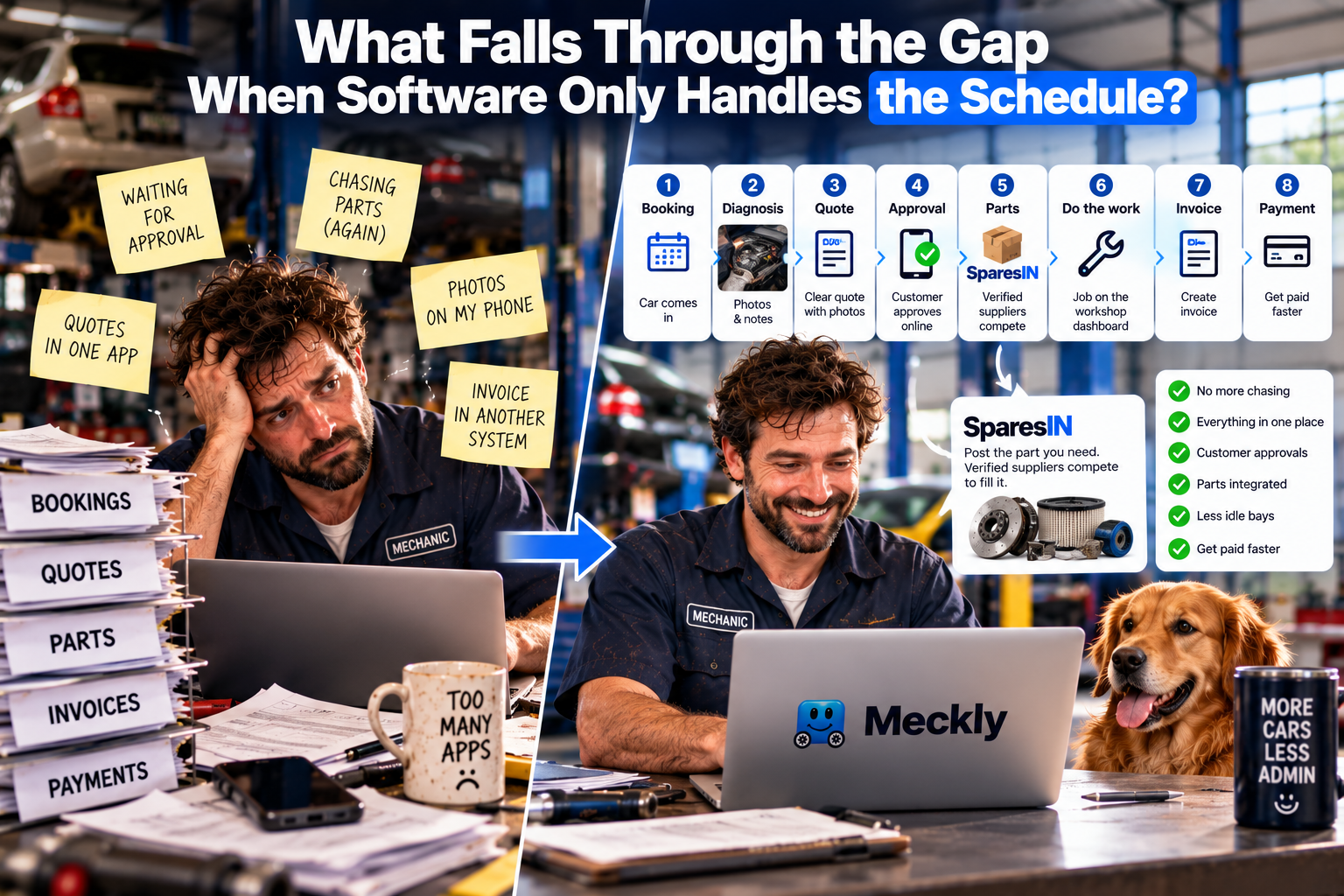
- SparesIN, the auto-parts marketplace. A workshop posts the part it needs, and vetted local suppliers compete to fill it, integrated straight into a Meckly quote. Unlike most marketplaces, it is not open to anyone with a part to sell. Suppliers are verified shops, vouched for by real workshops, properly business-to-business. You are not chasing. The prices come to you. It does not change how your workshop pays or collects, that stays intact, it just means cleaner records and faster sourcing without the hold music.
Each option has its place. The point isn't to abandon supplier relationships you've built over years. It's to stop letting the sourcing process be the reason a bay sits idle at eleven on a Wednesday morning.
Digital Job Cards Cut Six Phone Calls to OneRead nextDigital Job Cards Cut Six Phone Calls to OneThe Quote Approval Problem Nobody Talks About
A stalled quote is a stalled bay. That's not a metaphor. It's a physical fact. A car that can't be started because the customer hasn't approved the work is a car taking up space, stopping you from starting the next job, and generating zero revenue for the time it sits there.
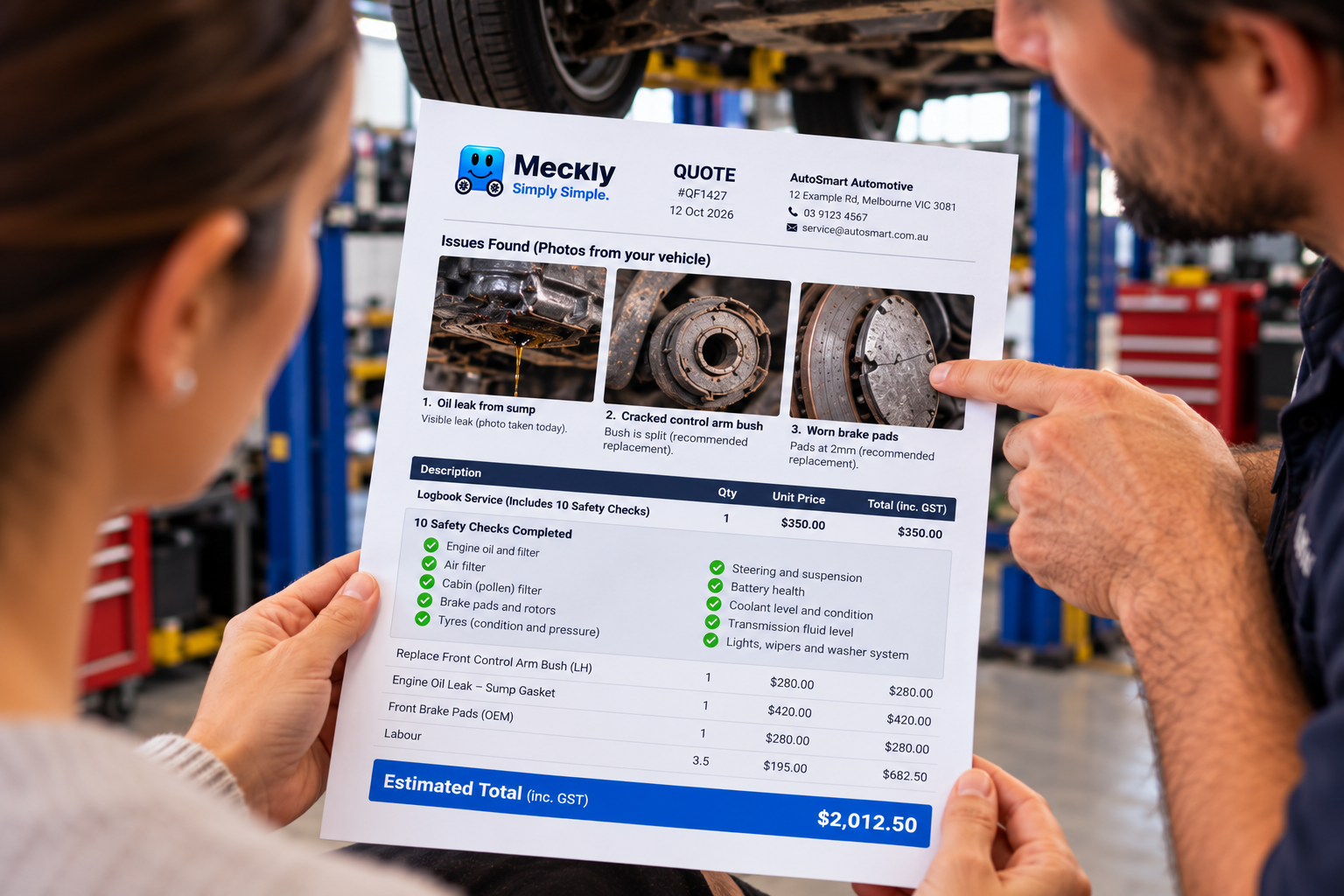
The fix isn't chasing customers harder. It's making approval so frictionless that it happens before they've had time to forget. A quote that arrives as a clear, readable document with a photo of the actual problem sitting right next to the line item and the price removes most of the hesitation. The customer can see what's wrong, see what it costs to fix, and approve it from their phone.
That's what good workshop management software is supposed to do. In Meckly, the diagnostic images are saved directly on the quote itself. Not in a separate folder, not in a second app, not texted over and then lost in someone's camera roll. The photo of the problem lives next to the price the customer sees. One source of truth. It builds trust and cuts disputes before they start.
Closing the Loop: What a Fixed Day Actually Looks Like
Go back to that busy Wednesday. Six jobs. The difference isn't fewer jobs or a lighter phone. The difference is that parts sourcing happened in the background while you were already under the bonnet on the first car. Quotes went out with photos attached and came back approved before morning tea. Invoices closed the moment jobs closed. When a customer rang about a line item, the photo was right there on the quote they'd already approved and you both had it in front of you inside thirty seconds.
Same busy day. Different shape to the profit at the end of it.
Your busiest day doesn't have to be your least profitable. But that won't change until the process stops being the reason the money doesn't match the effort.
Frequently Asked Questions
Why does workshop productivity slow cash flow on busy days?
Busy days pile on invisible admin: phone calls for parts, manual quote approvals, customers who haven't responded, jobs that stall mid-bay. None of that time gets invoiced. You spend hours generating activity, but only the billed hours count toward profit.
How many hours a day do workshop owners lose to admin?
Industry figures commonly cite three to five hours a day on tasks that have nothing to do with fixing cars: chasing parts, following up approvals, writing up jobs manually. On a busy day, that number climbs because there are more jobs to chase and more people to call.
What is the difference between a busy workshop and a profitable one?
A profitable workshop bills a high percentage of the hours it actually works. A busy workshop generates lots of activity, some of which never gets invoiced. The gap between those two is almost always admin, parts delays, and unapproved quotes sitting idle.
How does parts sourcing affect workshop cash flow?
Every minute spent ringing suppliers, waiting on hold, or leaving voicemails is unbilled time. Parts delays also hold up bays, which means a job that should close today rolls to tomorrow, and the invoice goes out a day later than it needed to. As one trade guide puts it, a busy workshop can be profitable on paper and cash-poor in reality.
What is SparesIN and how does it help workshop owners?
SparesIN is the auto-parts marketplace where a workshop posts the part it needs and vetted local suppliers compete to fill it. It is integrated directly into a Meckly quote, so you are not ringing around. Suppliers are verified businesses, vouched for by real workshops, not a free-for-all open to anyone with a part to sell.
How does workshop management software reduce slow cash flow?
Good workshop software keeps quotes moving by making it easy for customers to approve jobs digitally, attaches photos to line items so customers see the evidence next to the price, and keeps records clean so nothing falls through the cracks. Faster approvals mean faster starts, faster completions, and invoices that go out the same day the job closes.